
Turkey Eliminates Diesel SCT to Combat Rising Fuel Costs

In an effort to mitigate the inflationary pressures caused by global geopolitical tensions, the Turkish government has officially eliminated the Special Consumption Tax (SCT) on diesel fuel effective immediately. The decision, published in the Official Gazette, serves as a response to the volatility in the Strait of Hormuz, which has significantly disrupted global fuel supply chains and driven up transport costs. This strategic adjustment aims to provide immediate relief to the transportation and logistics sectors, which have been struggling with surging diesel prices throughout the year. The policy marks a temporary departure from the previous Esel Mobil system, shifting towards a structured tax stabilization model to protect the domestic market.
- The government has completely removed the SCT on diesel fuel until the end of August.
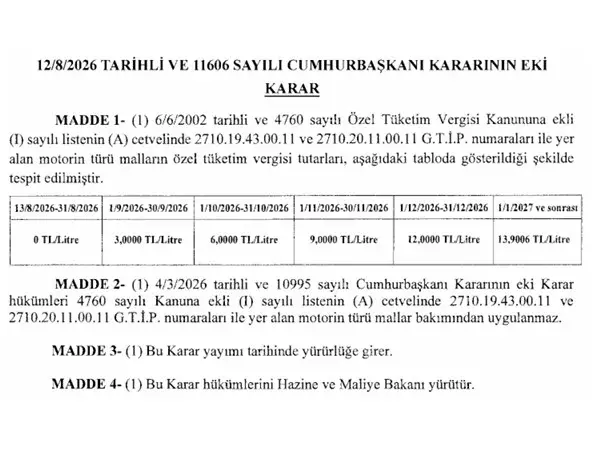
- A phased increase in tax rates will be implemented starting in September until reaching 13.90 TL in January.
- Market analysts project that diesel pump prices may stabilize between 65 TL and 70 TL.
- The current tax exemption applies exclusively to diesel, leaving gasoline and LPG prices unchanged.
Diesel Taxes Will Increase Gradually After August
Following the zero-tax period that lasts until the end of August, the government has established a clear roadmap for the reintroduction of the SCT. This gradual increase is intended to balance fiscal needs with the necessity of keeping fuel costs manageable for the commercial sector. According to the new regulation, the tax will be set at 3 TL per liter in September, 6 TL in October, 9 TL in November, and 12 TL in December.
Starting in January, a permanent tax rate of 13.9006 TL per liter will be applied to diesel fuel sales nationwide.
This structured approach provides predictability for businesses that rely on long-haul logistics. By providing a clear timeline for the tax normalization process, policymakers hope to dampen the inflationary impact that sudden fuel price spikes typically exert on consumer goods.
Market Analysts Evaluate Potential Pump Price Changes
While the elimination of the SCT is a significant policy shift, the final impact on pump prices remains a subject of intense discussion among industry experts. Market participants are closely monitoring global crude oil benchmarks, as international price fluctuations could offset the benefits of the domestic tax reduction. Current estimates suggest that despite the removal of the SCT, regional variations and global supply factors might place the price of a liter of diesel between 65 TL and 70 TL.
The automotive and logistics sectors are particularly attentive to these developments. As fuel represents the largest operational expense for fleet operators, any stabilization in pricing is viewed as a vital step toward maintaining national supply chain efficiency. While diesel consumers benefit from this new regulation, owners of gasoline and LPG-powered vehicles will see no changes in their current tax structures, as those categories remain outside the scope of the recent decree.
We would love to hear your thoughts on these new fuel tax regulations; how do you believe this shift will impact your daily expenses or the broader economy in the coming months?
Your comment has been submitted,
it will be published after approval.