
Wireless Barcode Scanner Security Vulnerabilities Threaten Global Retail Networks


Kaspersky Security Services researchers have identified critical wireless barcode scanner security vulnerabilities that threaten to cripple warehouse and retail operations worldwide. By exploiting a lack of authentication between handheld devices and their base stations, attackers can utilize Bluetooth connectivity to bypass security layers and execute arbitrary code on connected workstations. As global e-commerce volumes surge past the 6 trillion dollar mark, these ubiquitous hardware components are becoming silent entry points for cybercriminals. Because these scanners are deeply integrated into the heart of modern supply chains, a single compromised device can effectively serve as a Trojan horse, granting malicious actors unauthorized access to sensitive operational technology and internal enterprise networks.
- Lack of authentication between barcode scanners and base stations allows attackers to inject malicious keystroke commands.
- Modern retail and logistics ecosystems face systemic risks as compromised peripheral devices can lead to full warehouse management system breaches.
- Security experts emphasize that hardware vulnerabilities in warehouse equipment enable persistent unauthorized access to secure operational networks.
- Organizations must implement strict device verification and network segmentation to mitigate the risks posed by insecure wireless peripherals.
Attackers Mimic Keystrokes Through Bluetooth Exploitation
Modern logistics centers have evolved into complex, hyper-connected technology ecosystems where hundreds of devices communicate constantly. In a typical warehouse setup, wireless barcode scanners transmit data to a local base station, which then relays that information to a primary server. The fundamental vulnerability discovered by Kaspersky experts lies in the communication link between the scanner and the receiver, which lacks a robust authentication mechanism.
The attack sequence is remarkably quiet and requires no direct user intervention. An attacker lurking within the range of a facility can passively monitor Bluetooth traffic to capture a base station’s MAC address. Once identified, the attacker connects their own device to the base station, masquerading as a legitimate scanner. The system then accepts malicious data payloads as Human Interface Device (HID) keystrokes. Consequently, the workstation processes these inputs as if they were typed by an authorized employee, allowing the attacker to execute unauthorized commands and gain an initial foothold within the operational technology network. 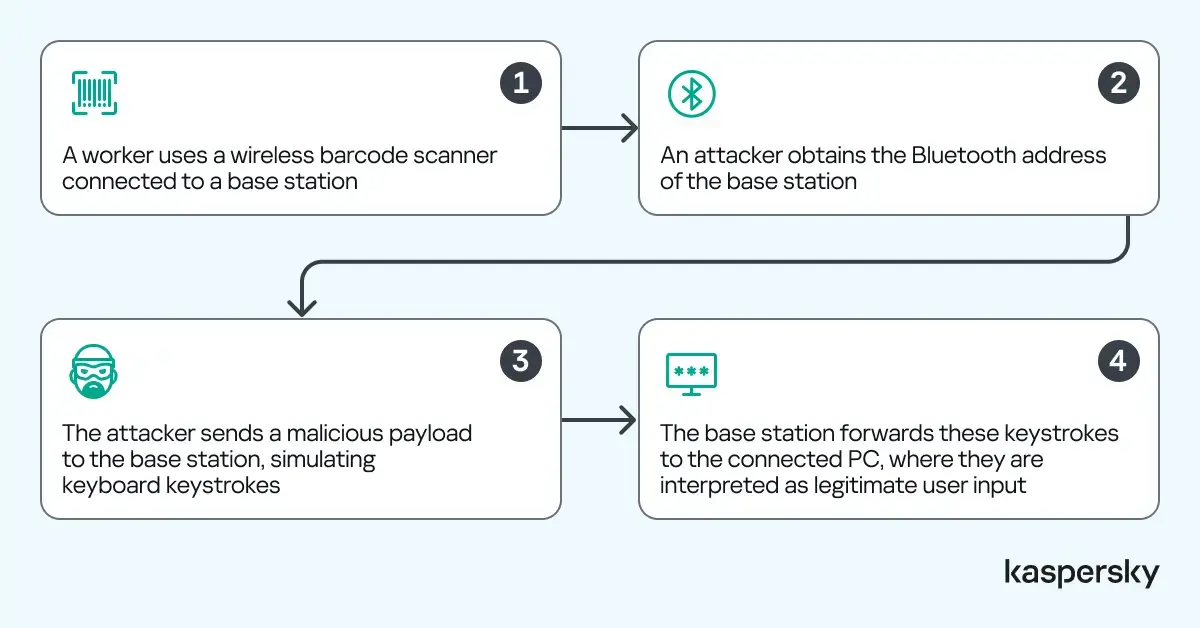
Entire Warehouse Ecosystems Face Significant Security Risks
Researchers warn that this method is merely the tip of the iceberg, as the vulnerability affects hardware from multiple major manufacturers. Once a workstation is compromised, the attacker resides within the trusted corporate network, often with direct access to critical infrastructure. This risk extends far beyond simple barcode scanners. Portable Data Terminals (PDR) used by field staff, network-connected thermal label printers, and even central Warehouse Management Systems (WMS) are all potential targets. Because these devices are often treated as peripheral equipment, they frequently lack the rigorous security patching cycles applied to servers and desktop computers, making them ideal backdoors for long-term espionage or sabotage.
Logistics and Retail Sectors Must Strengthen Defense Mechanisms
With global e-commerce sales doubling since 2019, any disruption to logistics operations can lead to massive financial losses and supply chain crises. Sergey Sidorov, Head of Industrial Security Services at Kaspersky, emphasizes that the extreme level of digitization in today’s retail world means that every single connection point is a potential liability. To combat these threats, organizations should adopt a multi-layered security strategy. This includes verifying every new hardware component before integration, disabling unused Bluetooth interfaces, and strictly segmenting network traffic. Furthermore, maintaining up-to-date firmware on all edge devices is essential to close known security gaps. Companies should also conduct regular penetration testing and red-teaming exercises to simulate internal threats and identify weak points in their infrastructure before malicious actors can exploit them.
Have you noticed any unusual behavior in your workplace’s wireless hardware, or does your facility have strict protocols for managing peripheral device security? Share your thoughts and experiences in the comments section below to help others stay secure.
Your comment has been submitted,
it will be published after approval.