
Special meeting with the President of Qualcomm Automotive Division


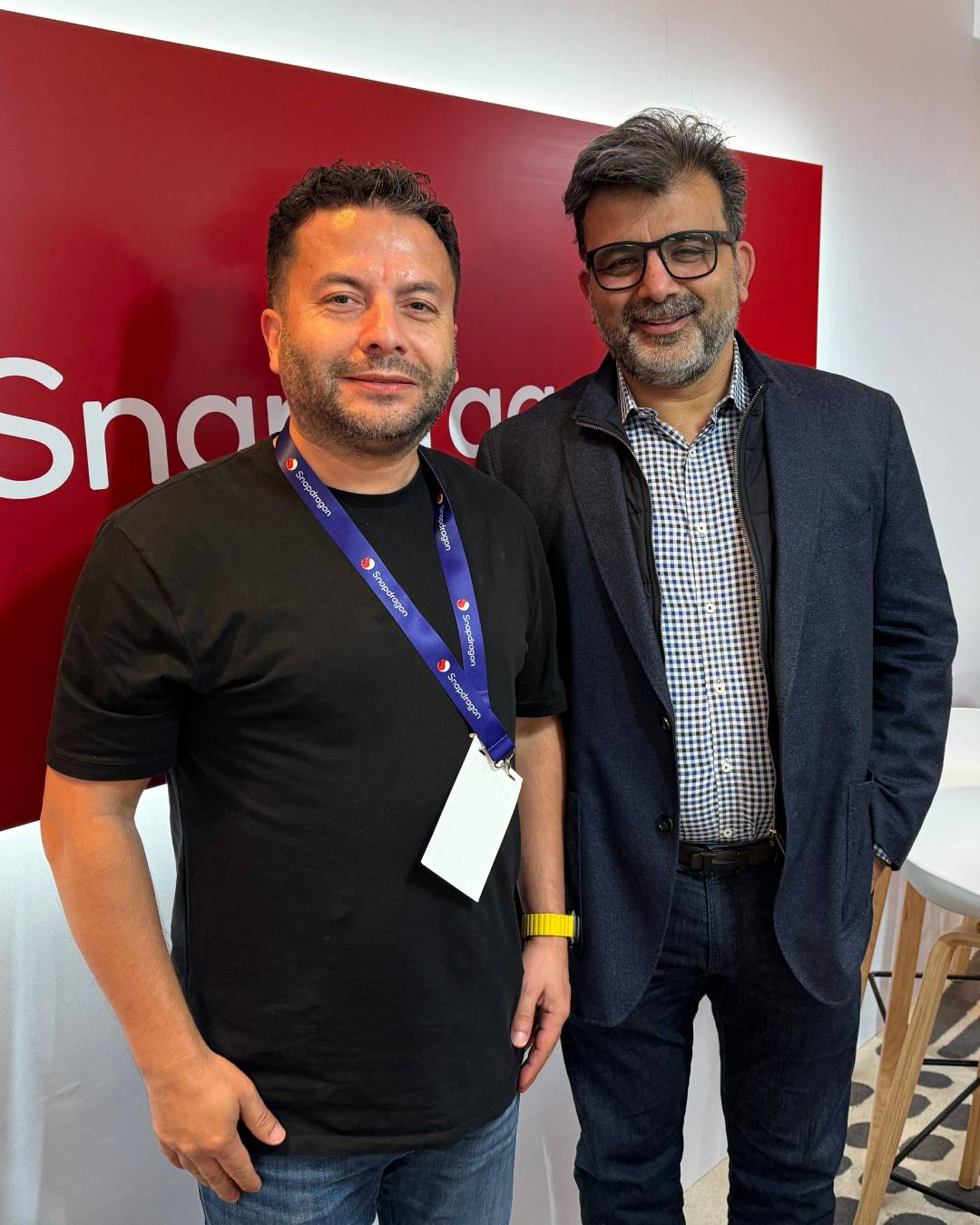
We held a special press conference with Nakul Duggal, Group General Manager responsible for Qualcomm Automotive, Industrial and Cloud Computing Business Units, as part of the Computex 2025 fair.
In this meeting, which ShiftDelete.Net founder Hakkı Alkan also attended, the head of the team that developed the Snapdragon Cockpit Platform, which is also used in our domestic car Togg, shared important information about the company’s strategies in the industrial IoT and automotive fields.
Special meeting with the President of Qualcomm Automotive Business Unit Nakul Duggal
Four-category Edge AI strategy in Industrial IoT
Duggal opened the meeting by asking attendees questions to get to know Qualcomm’s presence in both the industrial IoT and automotive sectors. He began by explaining the company’s strategy in these areas, focusing specifically on Edge AI and what that means for industrial environments.
“ Last year, when we started thinking about what Edge AI meant and what our role was for an industrial environment, the question arose as to how we were going to play a role in this established, slow-moving, risk-sensitive market that didn’t have a lot of incentive to drive big changes, ” Duggal said. “After talking to customers, they realized there was a huge desire for change but no well-defined ecosystem to drive that change.”
Duggal explained that over the last 15-20 years, industrial applications have generally evolved around computing power, with companies such as Intel, NXP, Renesas, TI and ST Micro playing important roles in this area. He noted that Qualcomm does not focus on this category because it is not part of their overall strategy.
Duggal, who stated that they have made progress in three main areas: connectivity, computation and Edge AI, explained that they have worked with various customers to understand exactly what Edge AI means. He explained that they have interviewed customers in different areas from the oil and gas sector to the retail sector and divided the machine-by-machine Edge AI topic into four different categories:
“ After a year of thinking about edge AI, we’ve seen that it really falls into four different categories. If you look at time series data, temperature, pressure, location, you can look for anomalies from the trend you expect and extract intelligence from the change that’s happening at the edge.
“You don’t have to send data to the cloud and run analytics in the cloud. You can run it at the edge. You can apply the same logic to audio, voiceprint, and voice signature, and that gives you a tremendous amount of intelligence. Of course, you can do that for vision and cameras. And then you can take that to a multimodal level by applying it to robotics and drones .”
Duggal said they spent time thinking about Edge AI sitting right at the edge of your network and extracting intelligence from there, and what kinds of solutions and services can be created once that intelligence is extracted. The second layer they added to that is “Gen AI” (Generative Artificial Intelligence).
“ If you have a human interacting with a machine, the human needs to understand what’s happening at the edge in human form. That’s where Gen AI comes in, where you can translate what’s happening at the edge by feeding it into a LLM (Large Language Model) .”
The meeting also discussed the unique features in Qualcomm’s technology portfolio and the challenges of tailoring them to various end products. Duggal noted that the company spent a lot of time on this product-market fit segmentation.
Advantech partnership and portfolio that makes a difference
Duggal explained that at Computex, they announced a partnership with Advantech and that’s to bring parts of their portfolio from an AI perspective into Advantech’s portfolio. It’s about bringing that capability into their portfolio wherever AI is needed at the edge, whether it’s an edge box, a module, an on-premise device.
“ No other competitor really fits in well with the portfolio we have because of the breadth of our footprint. We’re not like Nvidia because of all the connectivity and low power features we offer. We’re not like NXP because we offer a huge amount of Edge AI. We’re not like Intel because Intel is mostly focused on compute ,” Duggal said.
Focus.ai acquisition and 35-camera smart city technology
Duggal also noted that Qualcomm has acquired some companies like Edge Impulse and Focus.ai in the last year. Edge Impulse offers a platform for machine learning operations, while Focus.ai focuses on the security and surveillance space.
“ In this space, we’re taking video data and extracting information that might be of interest from a security or surveillance perspective. For example, does the person have a gun, what is the person wearing, what is the license plate of the vehicle, what is the make and model? All these different models can work on that frame, or you can take the video stream and feed it into a box that sits on the edge and do the processing there. Once you’ve done that processing, you can annotate the frame with relevant feature information, then feed it to a reasoning agent and ask it questions about what you’re seeing ,” Duggal said, explaining Focus.ai’s solution.
Duggal then elaborated on the smart city use case, explaining that up to 35 simultaneous video streams are running on a single chip and feature extraction is performed for each video stream.
“ You can take 30 cameras, feed the output of each camera into a single SOC. The SOC extracts the necessary features, labels them, and sends them to a second chip running a reasoning agent, and you can ask all kinds of questions. You couldn’t do any of that without Edge AI. In previous systems, storing and processing was very expensive, very cumbersome, and very difficult to maintain. They were mostly CPU and storage-type systems. This completely changes the way these systems are built now .”
The fifth generation of the Snapdragon Cockpit Platform, also used in Togg, is coming
The automotive topic was also discussed at the meeting. Talking about Qualcomm’s cockpit business, Duggal said, “ Our cockpit business is going very well. We are currently building our fifth-generation platforms and they will be available in the first half of next year .” He noted that the company has a presence in almost every automaker globally and has a large footprint in China in particular.
“ The big shift we saw a few years ago was that carmakers wanted to differentiate the cockpit. The phrase that’s common in China is ‘smart living space.’ Customers spend a lot of time in their cars. Cars have become cabins where you want a lot of human comfort, a good environment. And along with that kind of comfort is a digital experience ,” Duggal said, adding that they’ve done a lot of innovation with their partners and customers in the cockpit, and that’s served the company really well.
“ It’s a well-established, global business and it’s doing pretty well,” Duggal concluded, noting that they’ve worked with Google, the Chinese ecosystem, Epic Games (for Unreal Studios), DSP Concepts (for audio experiences), and various security companies .
Your comment has been submitted,
it will be published after approval.