
Voyager 1 Ends 48-Hour Silence, Power Fix Extends Its Science

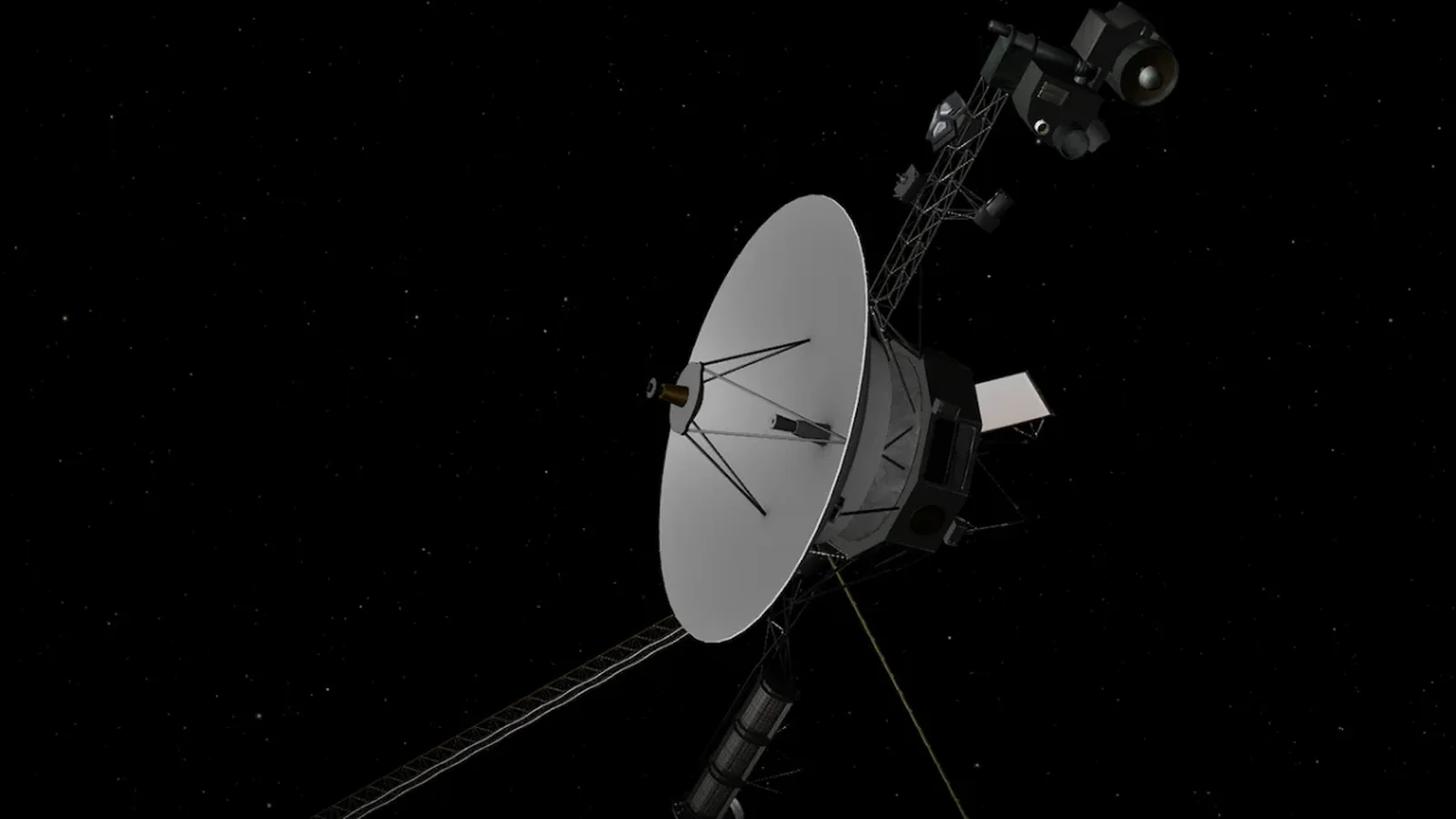
NASA says Voyager 1 is back in steady contact after a 48-hour communication loss that ended on October 20, 2026, and that a power-saving overhaul completed in September will keep the probe’s remaining science instruments running longer than expected. The 49-year-old spacecraft is now weeks away from becoming the first human-made object to reach one light-day from Earth.
What Caused the Voyager 1 Communication Loss?
NASA’s Deep Space Network, the agency’s network of large radio antennas in California, Spain and Australia, could not detect Voyager 1’s signal during two scheduled contacts on October 18 and 19, taken 24 hours apart. The signal came back on October 20, before engineers had even sent troubleshooting commands, and the link has held since then.
The root cause is still under investigation. So far, the team at NASA’s Jet Propulsion Laboratory (JPL) has found that one group of thrusters, the small engines that keep the probe pointed at Earth, went offline and the backup set switched on automatically. That swap is part of Voyager’s fault protection: when the onboard computers detect a problem with the active thrusters, the spacecraft moves to a safe configuration and pauses normal operations so engineers can diagnose it.
Thruster health has been a long-running concern. In 2025, JPL revived a set of roll thrusters that had been considered unusable since 2004, precisely so Voyager 1 would have a working backup if residue clogged the primary set.
The “Big Bang” Power Fix
The good news came first. In early September, engineers turned off three devices on Voyager 1 and replaced them with three lower-power alternatives in a single operation the team nicknamed the “Big Bang”. The same swap was done on Voyager 2 about six weeks earlier as a safer test.
All six devices help keep the spacecraft warm enough to work in deep space, which is why the change had to happen at once: only a simultaneous swap could cut power use while keeping heat distributed correctly. According to NASA, without the Big Bang another Voyager 1 instrument would have had to be switched off as early as summer 2027.
- Power source: radioisotope thermoelectric generators that turn heat from decaying plutonium into electricity.
- Power loss: about 4 watts per year on each Voyager probe.
- Instruments still on: the magnetometer and plasma wave subsystem; the cosmic ray subsystem was turned off in February 2025 and the low-energy charged particles experiment in April 2026.
Voyager 1 Reaches One Light-Day on November 18
Voyager 1 is traveling at about 38,000 mph (61,155 km/h). On November 18, 2026, at 5:16:07 a.m. EST (10:16 UTC), it will be 16.09 billion miles (25.89 billion kilometers) from Earth, the distance light travels in one day. From then on, a command takes 24 hours to reach the probe and its reply takes another 24 hours.
“If you want to say ‘hello’ to Voyager, you send your message and then you go home and you wait two days before you finally get a response,” Voyager project manager Suzanne Dodd said in NASA’s announcement.
Nothing will change on board when Voyager 1 crosses the mark. The milestone matters because it shows how far a spacecraft launched in 1977 has traveled. Voyager 1 and Voyager 2 remain the only spacecraft to directly study interstellar space, the region outside the heliosphere, the bubble of particles and magnetic fields created by the Sun.
What It Means for the Mission
The Big Bang buys time, but the probes’ power will keep falling every year, and the thruster event shows that a half-century-old spacecraft can still surprise its team. For now, both Voyagers keep sending interstellar data home. For more space news, see our coverage of Starship Flight 15, NASA’s solid-state battery that survives -170 degrees and Turkey joining the Artemis Accords.
Sources: NASA JPL, NASA Science: Where Are Voyager 1 and 2 Now?, NASA Voyager blog
Your comment has been submitted,
it will be published after approval.