
Amazon Leo Surpasses 1,000 Satellite Production Milestone

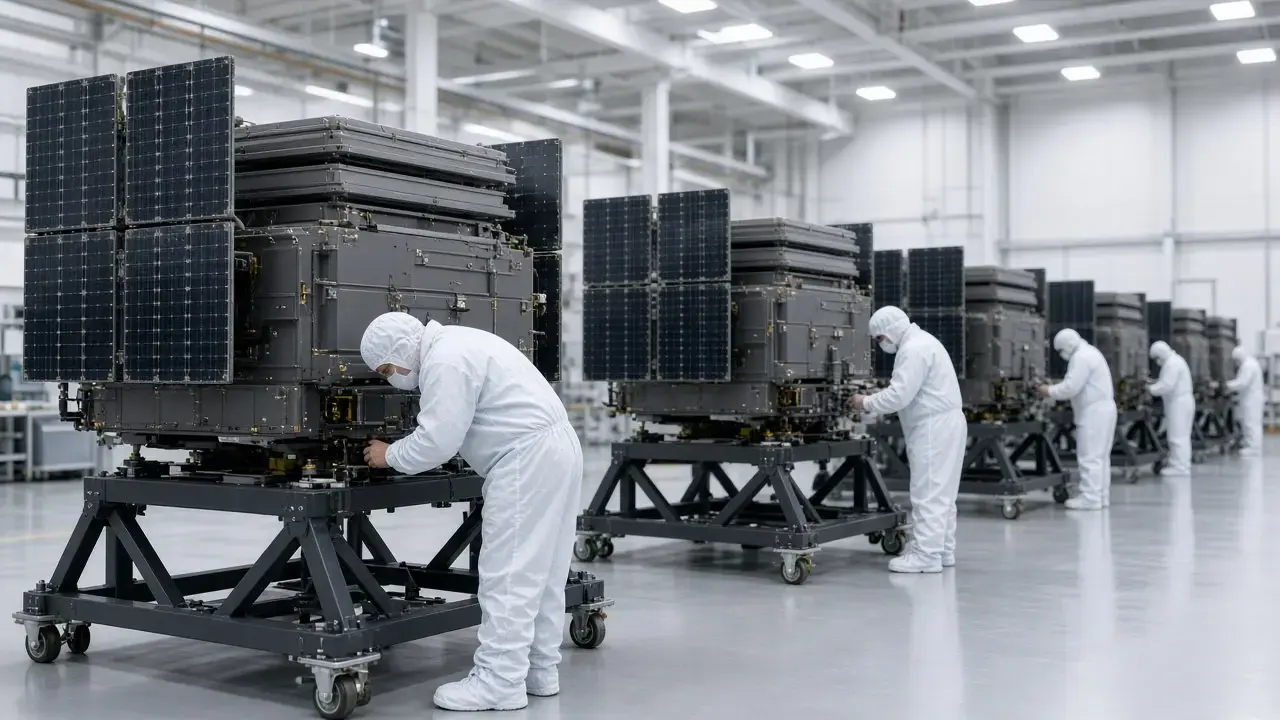
Amazon’s ambitious low-Earth orbit (LEO) internet project, Amazon Leo, a direct competitor to Starlink, has achieved a significant manufacturing milestone. The company announced on October 22 via its official X account that its factory in Kirkland, Washington, has successfully built over 1,000 Amazon Leo satellites. This facility is continuously engaged in the production, testing, and shipment of these advanced spacecraft, with units for upcoming Vulcan and Ariane 6 rocket missions being prepped at Cape Canaveral and Kourou, French Guiana, indicating a robust progression towards deployment.
- The Kirkland, Washington, factory, spanning approximately 16,000 square meters, currently possesses the capacity to produce five satellites daily.
- More than 1,000 Amazon Leo satellites have been manufactured, representing over one-third of the first-generation constellation target of 3,200 spacecraft.
- Despite rapid production, the deployment of Amazon Leo satellites faces bottlenecks due to delays with launch vehicles like ULA’s Vulcan and Blue Origin’s New Glenn rockets.
- Amazon Leo maintains its commitment to launching commercial service in 2026, initially targeting the US, Canada, UK, France, and Germany, with no specific timeline announced for Turkey.
Kirkland Factory Boosts Production to Five Satellites Daily
The facility in Kirkland, Washington, is a critical hub for Amazon’s space internet ambitions. This approximately 16,000-square-meter plant is engineered to produce up to five satellites per day. Each satellite, weighing over 450 kilograms, is composed of roughly 4 million individual parts and is entirely designed and manufactured in-house by Amazon. Over 500 engineers and technicians are employed at the factory, driving the continuous production and testing of the Amazon Leo fleet. The company highlights that the more than 1,000 satellites produced so far constitute over one-third of the entire first-generation constellation, which is planned to include more than 3,200 satellites.
Amazon Leo Significantly Increases Satellite Production Speed
The increase in production speed at the Kirkland factory has been remarkable. Initially, Amazon was able to produce three to four satellites per month before its first mission. Today, the facility matches or exceeds that monthly output on a daily basis. Rajeev Badyal, who heads Amazon Leo, stated in an interview with Ars Technica that it took six months to produce the first 27 satellites. Now, the team can comfortably produce 27 satellites in just one week. Completed satellites are shipped to Florida every two to three days, where hundreds await launch at the Kennedy Space Center facility.
Rocket Delays Present Primary Bottleneck for Leo Deployment
Despite the impressive manufacturing pace, the primary challenge for Amazon Leo’s deployment lies with rocket availability. According to Amazon’s official mission tracking page, 14 missions since April 2025, utilizing Atlas V, Falcon 9, and Ariane 6 rockets, have collectively sent 396 satellites into orbit. Amazon has confirmed that only four of these satellites have been deorbited, meaning approximately 392 remain active. Independent tracking platforms like KeepTrack corroborated this number as of mid-October. The most recent launch involved 29 satellites via an Atlas V on July 2.
Reports from Via Satellite indicate that the unavailability of ULA’s Vulcan rocket and Blue Origin’s New Glenn rocket has slowed down the constellation’s installation. Badyal mentioned that the return-to-flight mission for Vulcan would carry Leo satellites and was only “weeks” away. The next Ariane 6 mission, set to carry 36 satellites, is scheduled for no earlier than November 23 from Kourou. Amazon remains committed to deploying its entire 3,200-plus satellite network by July 30, 2029, as reported by Light Reading.
Amazon Leo Aims for 2026 Commercial Service Launch
The initiative, long known as Project Kuiper, was officially rebranded as Amazon Leo on November 13, 2025. Chris Weber, Vice President of Business and Product for Amazon Leo, reiterated that the initial commercial service will commence in 2026. Weber highlighted the network’s claimed ability to deliver 1 Gbps download and 400 Mbps upload speeds as a significant advantage over Starlink. Ars Technica noted that Delta Air Lines’ decision to choose Amazon over Starlink for its aircraft connectivity reportedly angered SpaceX founder Elon Musk.
Heise Online reported in February that the service is initially planned for launch in the United States, Canada, the United Kingdom, France, and Germany. There is no official timeline announced by Amazon for service availability in Turkey. Turkish Ministry of Transport and Infrastructure officials stated to Anadolu Agency in March that discussions were underway with companies like SpaceX and Amazon regarding regulatory and security requirements for their systems in Turkey. A roadmap could be presented if these companies comply with the stipulated conditions.
What are your thoughts on Amazon Leo’s rapid satellite production and its potential to rival existing satellite internet services? Share your insights and predictions in the comments below!
Your comment has been submitted,
it will be published after approval.