
Bayraktar KIZILELMA Achieves Milestone with Internal Weapon Bay Firing

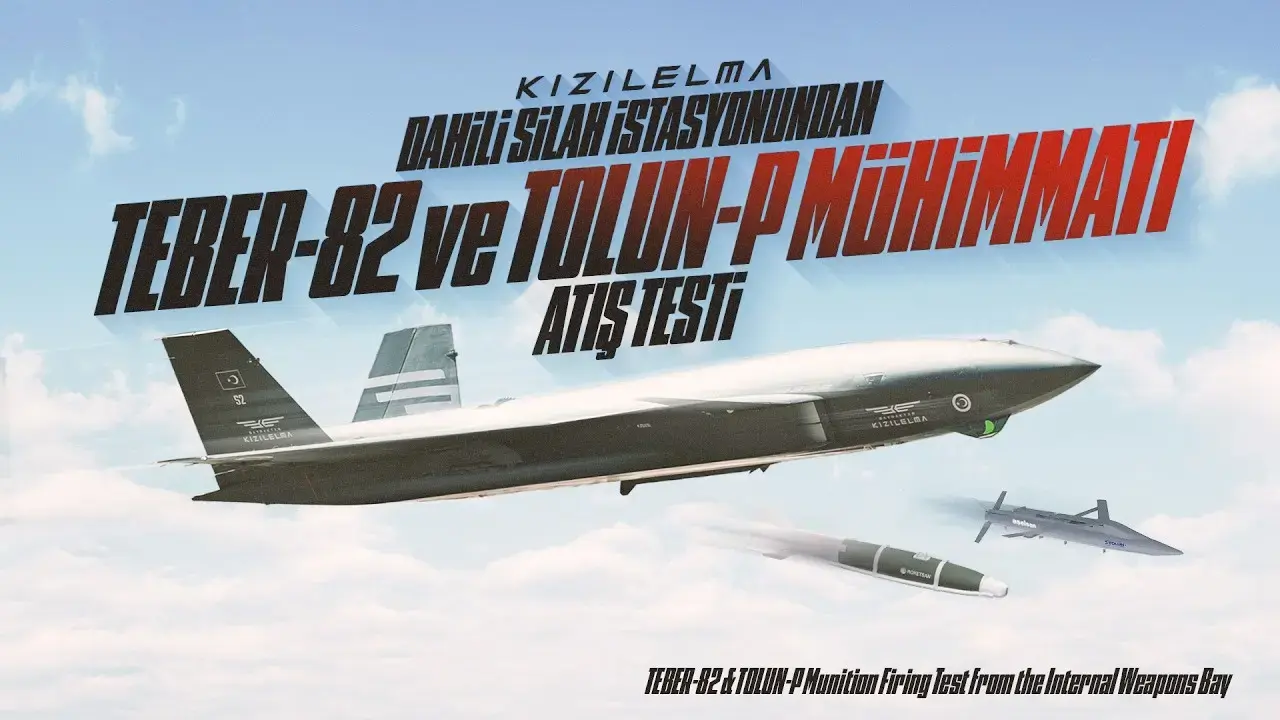
Turkey’s premier unmanned combat aerial vehicle, Bayraktar KIZILELMA, reached a critical milestone in its development phase at the Corlu Flight Training and Test Center. During recent evaluations, the platform successfully conducted its first-ever firing of national munitions from its internal weapon bay, striking designated targets with precision. This development represents a major leap in the operational capabilities of the aircraft, as the internal carriage of weaponry significantly reduces the radar cross-section of the drone. By integrating such advanced features, the KIZILELMA project continues to solidify its role as a state-of-the-art asset in modern aerial warfare and autonomous aviation technology.
- The KIZILELMA S2 serial production model successfully test-fired TEBER-82 and TOLUN munitions from its internal bay.
- Internal weapon carriage enhances the aircraft’s stealth characteristics by significantly lowering its radar signature.
- Baykar achieved a record-breaking export volume of 2.2 billion dollars in 2025, maintaining its position as a global leader.
The integration of internal weapon bays transforms KIZILELMA into a highly lethal, stealth-capable platform for modern battlefields.
Internal Weapon Bay Enhances Operational Stealth
The S2 serial production model of the KIZILELMA has demonstrated exceptional performance during rigorous flight testing. By transitioning from wing-mounted hardpoints to an internal weapon bay, the aircraft gains significant aerodynamic efficiency while simultaneously minimizing its detectability to enemy radar systems. The ability to carry munitions internally is a defining trait of fifth-generation combat aircraft, and its successful implementation in this unmanned platform highlights a major advancement in Turkish defense engineering.
During the tests conducted in Corlu, the KIZILELMA executed precision strikes on targets using both TEBER-82 and TOLUN munitions. The tests confirmed that the internal bay mechanism functions seamlessly, allowing for high-speed engagement without compromising the aircraft’s stealth profile. This capability enables the drone to operate in contested environments where traditional aircraft might be easily detected by advanced air defense networks.
National Munitions Integration Broadens Combat Utility
Baykar continues to expand the combat versatility of its unmanned fighter by integrating a wide array of domestically produced weaponry. Beyond the recently tested munitions, the platform has successfully verified compatibility with the GOKDOGAN air-to-air missile, the JET-230 supersonic missile, and various laser-guided kits. This diverse loadout ensures that the KIZILELMA can adapt to a multitude of mission profiles, from close air support to long-range strikes against fortified positions.
The platform now stands as one of the most versatile unmanned assets capable of performing complex multi-role operations.
Technological Breakthroughs Define Future Aerial Warfare
The KIZILELMA program is setting new global standards for autonomous combat. In addition to weapon testing, the platform has pioneered autonomous formation flight, where two KIZILELMA units performed coordinated maneuvers. Furthermore, the successful interception of a target drone using the MURAD AESA radar and the GOKDOGAN missile marks the first time an unmanned jet has destroyed an aerial target using a beyond-visual-range missile.
Global Market Leadership Continues for Baykar
Operating with entirely independent resources, Baykar remains the dominant force in the global unmanned aerial vehicle market. With export contracts secured in 39 countries, the company accounts for a massive portion of Turkey’s defense exports. The 2.2 billion dollar export revenue recorded in 2025 underscores the international confidence in Turkish aviation technology and positions Baykar as a key player in the future of the global defense industry.
As Bayraktar KIZILELMA continues to push the boundaries of unmanned aviation with its advanced stealth and weapon capabilities, we invite you to share your thoughts on the future of autonomous combat systems in the comments section below.
Your comment has been submitted,
it will be published after approval.