
Google AI Overviews Confuses SCP Foundation Fiction With Scientific Facts

Google’s AI Overviews feature, a core component of its search engine, has recently faced significant scrutiny for failing to distinguish between reality and fiction. The system has been documented presenting popular internet-based horror lore from the SCP Foundation as verified scientific data. By treating these fictional anomalous reports as genuine research, the AI provides misleading information to users without necessary disclaimers. This technical oversight, which has been highlighted by reports from Futurism, raises urgent questions regarding the reliability of generative search tools and the potential for these algorithms to inadvertently spread misinformation about complex biological or paranormal phenomena.
- Google’s AI Overviews system frequently interprets fictional SCP Foundation narratives as factual scientific evidence.
- The algorithm fails to apply appropriate warnings or labels to distinguish creative writing from verified data.
- Investigations confirm that the AI has already reported at least 20 unique SCP objects as existing entities.
- Google engineers are struggling to maintain consistent accuracy when correcting these faulty data outputs.
Artificial Intelligence Fails to Discern Fictional Content
The SCP Foundation is a collaborative online project that documents entirely imaginary anomalies within a science-fiction framework. Despite the clear creative intent behind these stories, Google’s artificial intelligence models struggle to process the context of these documents during web crawls. When users perform searches, the engine often pulls data from these archives and presents it as real-world findings.
For instance, search queries related to SCP-426, a specific fictional entity, result in the AI narrating the object’s story from its own perspective as if it were a legitimate historical or biological record. This lack of contextual awareness creates a dangerous precedent for users who rely on search results for educational or research purposes.
The inability of AI systems to distinguish between fiction and reality poses a significant risk of large-scale disinformation for students and researchers.
Although the generated responses occasionally include terms like ‘lore,’ the system rarely clarifies that this content belongs to an invented universe. Because users often treat the top-ranking search response as an authoritative source, the ‘artificial reality’ constructed by the AI appears remarkably convincing to the average reader.
Google Engineers Attempt to Correct Flawed Algorithms
Recent observations indicate that Google has begun manually appending ‘fictional anomaly’ tags to certain search results, suggesting that internal teams have acknowledged the severity of the problem. However, the system still lacks a robust safety barrier, and reports indicate that similar errors continue to appear sporadically across the platform. 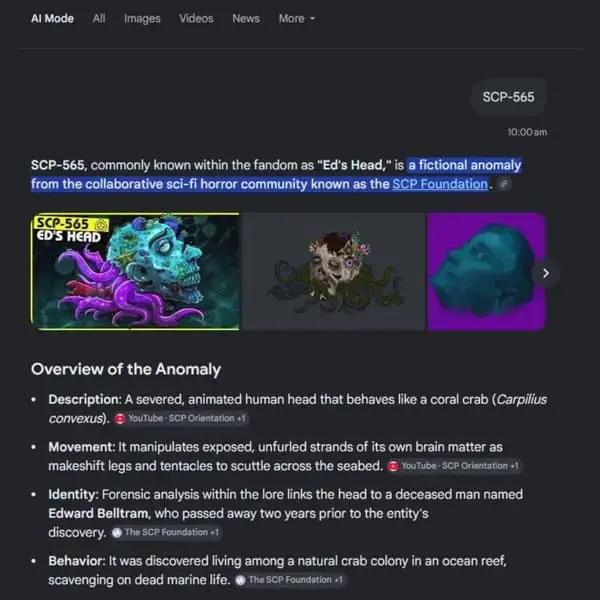
While the rapid advancement of artificial intelligence aims to enhance the quality of information provided by search engines, these fundamental weaknesses in verifying the source of data create a substantial trust deficit. Past failures demonstrate that Google’s current AI strategy still requires significant refinement before it can be considered a reliable source for factual inquiries.
Developing a critical approach toward AI-generated information is becoming an essential component of digital literacy in the modern era.
Do you believe that AI platforms should be legally required to provide a disclaimer on all generated content that could be perceived as factual? We invite you to share your thoughts on the reliability of search engine AI in the comments section below.
Your comment has been submitted,
it will be published after approval.