
Huawei Unveils Kirin 9050 Pro Processor for Mate XT 2

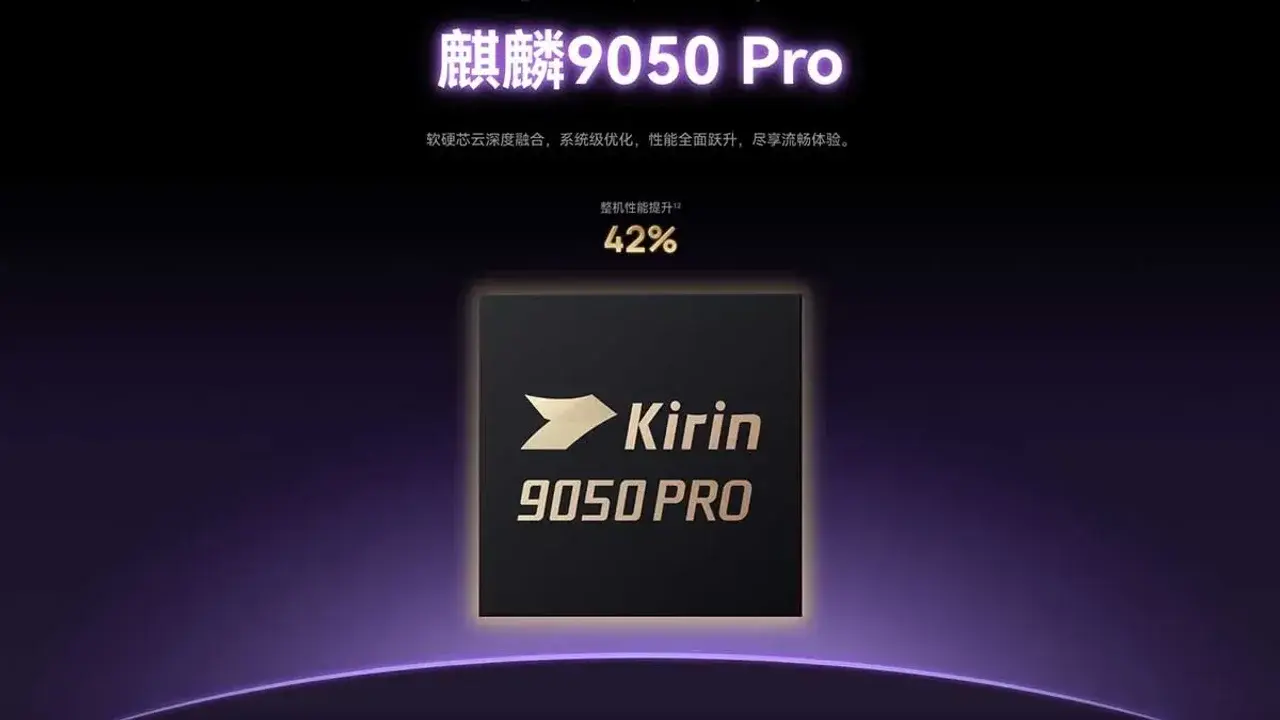
Huawei has officially unveiled the Kirin 9050 Pro, its most powerful mobile processor to date, marking a significant milestone in the company’s push for technological independence. Launched in the Chinese market on September 12, 2026, the new silicon powers the flagship Mate XT 2 smartphone. Huawei emphasizes that the chip is developed entirely without reliance on American technology, positioning it as a cornerstone of the company’s domestic hardware strategy. By integrating this advanced chip, Huawei aims to challenge global market leaders while further reducing its dependence on foreign semiconductor supply chains and established international manufacturing standards.
- The Kirin 9050 Pro delivers a 42 percent performance increase compared to the previous Kirin 9020 model.
- Huawei utilizes the proprietary LogicFolding manufacturing technique to stack logic circuits into dual silicon layers.
- The nine-core LinxiCore processor achieves clock speeds of up to 3.1 GHz while supporting sophisticated on-device artificial intelligence.
During the official launch, Huawei consumer group chairman Richard Yu highlighted the substantial performance gains achieved by the Kirin 9050 Pro. According to internal data provided by the company, the chip demonstrates a 24 percent improvement in single-core performance and a 52 percent increase in multi-core efficiency when compared to the Kirin 9030 Pro. Furthermore, the graphics processing capabilities have seen a massive 142 percent boost, supported by the Maleoon GPU which includes hardware-based ray tracing.  These figures reflect the capabilities of the nine-core LinxiCore unit and the Da Vinci NPU, which is designed to handle complex on-device models with up to 30 billion parameters. However, it is important to note that these performance metrics remain unverified by independent third-party laboratories.
LogicFolding Technology Optimizes Chip Performance
The Kirin 9050 Pro represents the first commercial application of Huawei’s innovative LogicFolding technology. Initially introduced by semiconductor chief He Tingbo at the IEEE ISCAS event in Shanghai, this method departs from traditional transistor shrinking. Instead of solely focusing on nanometer-scale reduction, the technique divides logic circuits into two active silicon layers joined face-to-face.  This architecture features approximately 50 million vertical interconnects spaced at 1.5-micrometer intervals. By shortening signal travel distances, Huawei claims it can enhance circuit density while simultaneously lowering the operating voltage, providing a unique alternative to conventional semiconductor manufacturing.
Production Processes Still Depend on Legacy Equipment
While Huawei has remained tight-lipped regarding the specific manufacturing node of the Kirin 9050 Pro, industry analysts suggest the use of SMIC’s third-generation 7nm N+3 process. The production line reportedly avoids extreme ultraviolet (EUV) lithography but continues to utilize ASML immersion scanners. Investigations by Bloomberg indicate that the manufacturing process relies on equipment from providers like Applied Materials and Lam Research, which were acquired by Chinese foundries prior to the implementation of strict 2022 export controls. Huawei’s successful transition away from American components, as seen in previous flagship devices, underscores the company’s long-term commitment to self-sufficiency in the high-stakes semiconductor sector.
We are eager to hear your perspective on this development; do you believe Huawei’s LogicFolding technology will successfully disrupt the dominance of traditional semiconductor manufacturing in the global market?
Your comment has been submitted,
it will be published after approval.