
Hyundai Spotted Testing New Compact Electric SUV Model


Hyundai has accelerated its expansion into the compact electric vehicle market after a mysterious new electric SUV model was recently spotted undergoing road tests in South Korea. As the company continues to implement its ambitious global strategy announced during the August CEO Investor Day, this prototype signals a significant step toward achieving its goal of introducing 100 new models by 2030. While the exact identity of the vehicle remains subject to speculation, the sighting confirms that Hyundai is actively diversifying its portfolio across North America, Europe, India, and its home market to maintain its competitive edge in the rapidly evolving electric SUV sector.
- Hyundai plans to launch 100 new vehicle models globally by 2030 as part of its long-term investment strategy.
- The manufacturer is developing several region-specific electric SUVs, including variants for the Indian, European, and global markets.
- The spotted prototype features a boxy design language that distinguishes it from the previously revealed IONIQ 3 hatchback.
- Technical specifications are expected to mirror those of the Kia EV3, potentially offering dual battery configurations for extended range.
Speculation Surrounding the Naming Convention Continues
Industry experts are currently debating whether this new vehicle will join the lineup as the IONIQ 4 or if it will mark the debut of the entry-level IONIQ 1. The confusion stems from a previous sighting of a prototype in China, which carried an HE1 testing label. Following Hyundai’s traditional nomenclature, where the suffix E indicates the use of the E-GMP platform, this designation suggests a smaller form factor than the existing IONIQ 5 and IONIQ 9. 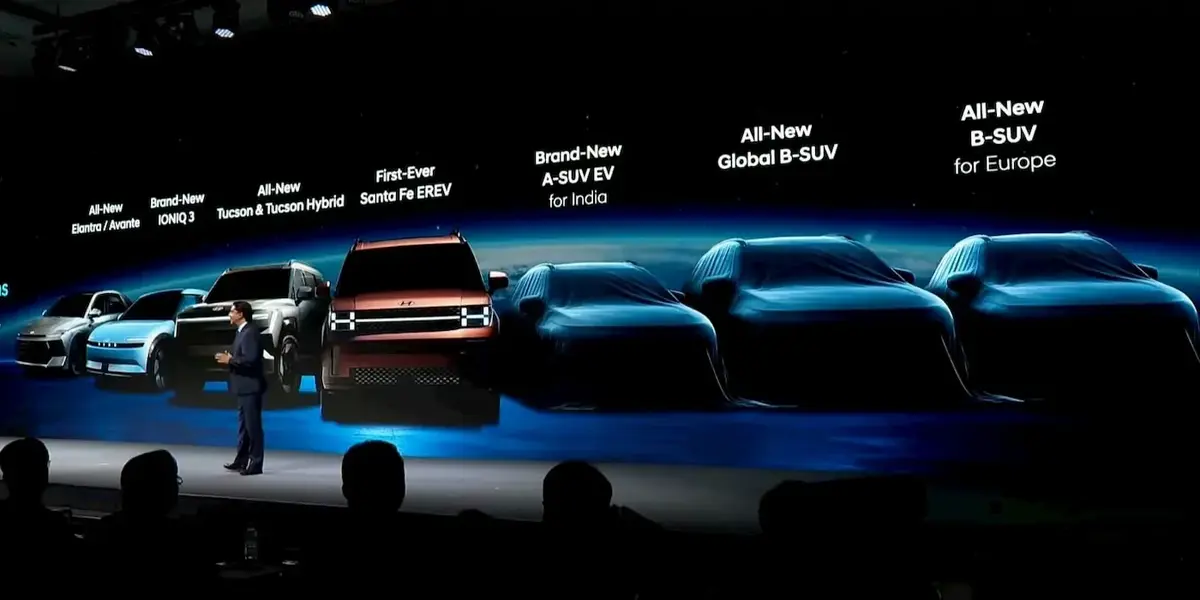
Although heavy camouflage obscures the finer details of the body, the vehicle displays a distinctively boxy silhouette. This design choice represents a departure from the lower, more aerodynamic profile observed on the IONIQ 3. Inside the cabin, the prototype is equipped with the latest Pleos Connect infotainment system, confirming that the vehicle will be positioned as a modern, technology-focused offering. 
Performance Expectations Align With Industry Standards
Market analysts predict that the new Hyundai model will share substantial design and engineering DNA with the Kia EV3. The structural similarities between the two brands suggest that the new SUV will prioritize interior utility and a vertical body shape to maximize cabin space. This alignment is not merely aesthetic, as it likely extends to the underlying powertrain architecture.
While official technical data remains undisclosed, it is highly probable that the model will utilize battery options similar to the EV3, which offers 58.3 kWh and 81.4 kWh capacities. Based on the WLTP cycle, these configurations provide ranges of up to 344 and 497 kilometers, respectively. By adopting these proven technologies, Hyundai intends to strengthen its footprint in the European and global compact segments.
As testing continues, the automotive community eagerly awaits further details regarding the final design and market positioning of this compact addition. The strategic importance of this project cannot be overstated as it represents a core pillar of the company’s commitment to vehicle electrification.
We would love to hear your thoughts on this new development; do you believe this vehicle should be marketed as the entry-level IONIQ 1 or the mid-range IONIQ 4? Please share your predictions in the comments section below.
Your comment has been submitted,
it will be published after approval.