
Intel Panther Lake Processors Debut at CES 2026

Tech giant Intel has made its long-awaited move at CES 2026, officially unveiling its next-generation mobile processors. The new Intel Panther Lake processors, built on the company’s advanced 18A manufacturing technology, are set to redefine performance for laptops, mini PCs, and even handheld gaming consoles. As part of the Core Ultra Series 3 family, these chips feature new P-core and E-core architectures, promising a new balance of power and efficiency.
Intel Panther Lake Processors: A Leap in Performance
The newly announced series showcases Intel’s mastery in multi-layered chip design. These processors are particularly ambitious on the performance front, consuming 40% less energy in single-core tasks compared to similarly powered competitors. Furthermore, the flagship model, the Core Ultra X9 388H, delivers a staggering 60% performance increase in multi-core tests according to Cinebench 2024 scores, successfully surpassing the AMD Ryzen AI 9 HX 370. These results prove that Intel’s focus on energy efficiency has paid off.
New Xe3 Architecture and Gaming Performance
On the graphics side, the processors feature the integrated Arc B390 graphics unit. Built entirely on the new Xe3 architecture, this unit exhibits 82% higher performance compared to the AMD Radeon 890M in 1080p gaming tests. As an industry first, the integrated GPU supports Multi-Frame Generation, promising a smooth experience for gamers. With this powerful graphics setup, Intel is targeting not only business laptops but also portable gaming devices.
Diverse Core Configurations
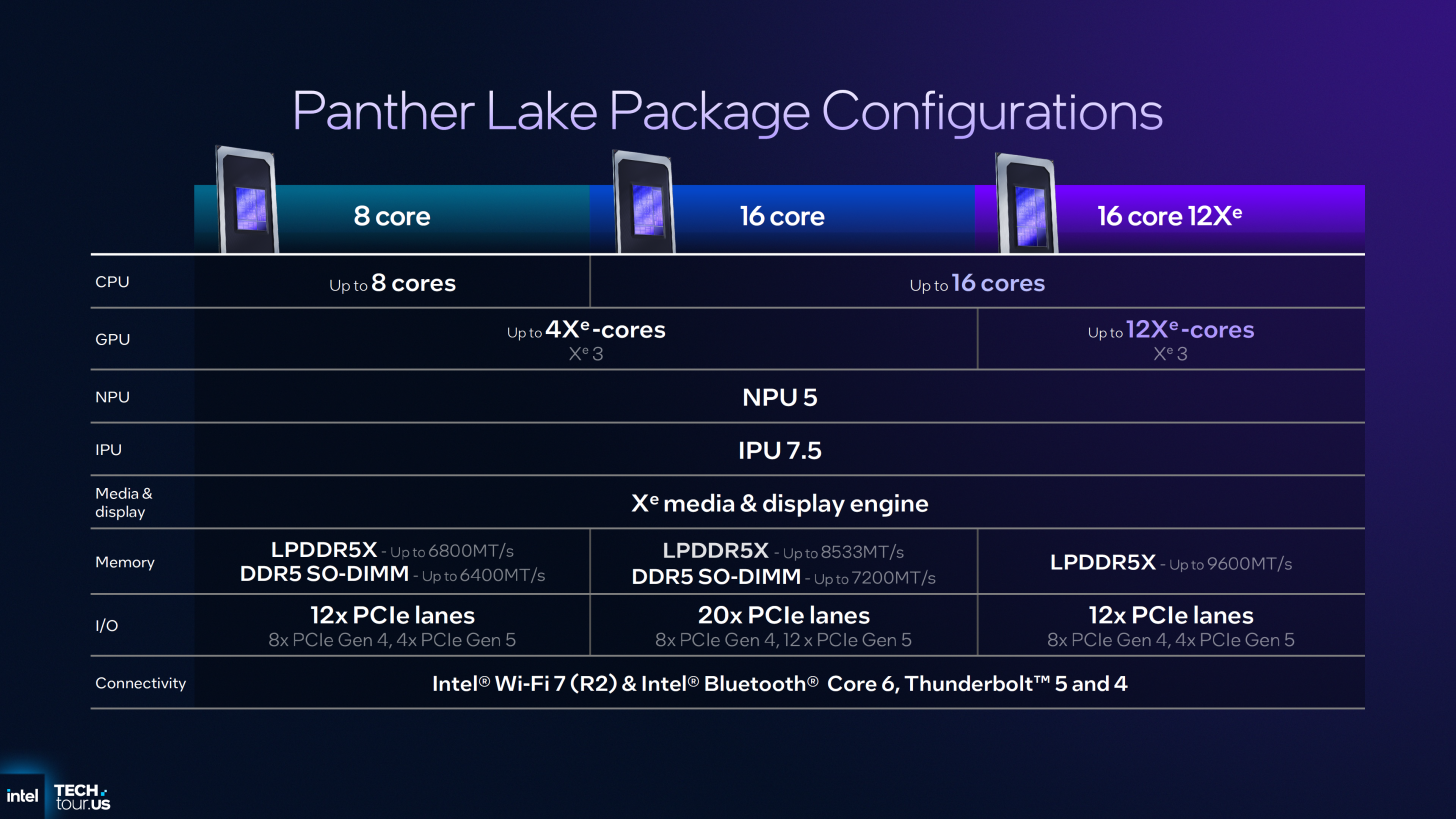
The Panther Lake family is launching with three different chip configurations. The entry-level structure, consisting of 4 performance cores and 4 low-power cores, will replace the Lunar Lake family. At the high end, 16-core models will take the place of the Arrow Lake-H series. Additionally, the top-tier configuration comes with 12 Xe graphics cores and offers LPDDR5X-9600 memory support, pushing graphics performance to its peak. This design, which uses a hybrid of TSMC and Intel manufacturing processes, offers both flexibility and high performance.
Intel’s transition to 18A technology is not just about performance gains; it also holds strategic importance. As the most advanced example of US-based manufacturing technology, this process strengthens Intel’s competitive position in the semiconductor market against Asia-based manufacturers. This technological leap is expected to set new standards in artificial intelligence and high-performance computing in the coming years.
Intel Core Ultra Series 3 Processor Family Specs
| Processor Model | P-Cores (Cougar Cove) |
E-Cores (Darkmont) |
LP-E Cores (Skymont) |
Max Clock Speed (GHz) |
Xe3 Graphics Cores |
TDP (Base / MTP) |
|---|---|---|---|---|---|---|
| Core Ultra X9 388H | 4 | 8 | 4 | 5.1 GHz | 12 | 25-80W |
| Core Ultra 9 386H | 4 | 8 | 4 | 4.9 GHz | 4 | 25-80W |
| Core Ultra X7 368H | 4 | 8 | 4 | 5.0 GHz | 12 | 25-80W |
| Core Ultra 7 366H | 4 | 8 | 4 | 4.8 GHz | 4 | 25-80W |
| Core Ultra 7 365 | 4 | 0 | 4 | 4.8 GHz | 4 | 25-55W |
| Core Ultra X7 358H | 4 | 8 | 4 | 4.8 GHz | 12 | 25-80W |
| Core Ultra 7 356H | 4 | 8 | 4 | 4.7 GHz | 4 | 25-80W |
| Core Ultra 7 355H | 4 | 0 | 4 | 4.7 GHz | 4 | 25-55W |
| Core Ultra 5 338H | 4 | 4 | 4 | 4.7 GHz | 10 | 25-80W |
| Core Ultra 5 336H | 4 | 4 | 4 | 4.6 GHz | 4 | 25-80W |
| Core Ultra 5 335H | 4 | 0 | 4 | 4.6 GHz | 4 | 25-55W |
| Core Ultra 5 325H | 4 | 0 | 4 | 4.5 GHz | 4 | 25-55W |
| Core Ultra 5 332 | 4 | 0 | 4 | 4.4 GHz | 2 | 25-55W |
| Core Ultra 3 322 | 4 | 0 | 4 | 4.4 GHz | 2 | 25-55W |
So, what are your thoughts on the new Intel Core Ultra Series 3 processors? Share your opinions with us in the comments!
Your comment has been submitted,
it will be published after approval.