
Jailbroken PS5 Runs 27B LLM Artificial Intelligence Model


A tech enthusiast has successfully transformed a jailbroken PlayStation 5 into a capable local artificial intelligence server, marking a significant milestone in homebrew hardware utilization. Using a modified console, Reddit user u/AdIllustrious7246 managed to run the 27-billion parameter Qwen3.8-27B large language model (LLM) by leveraging the system’s high-bandwidth GDDR6 memory. This innovative project pushes the boundaries of gaming hardware by shifting the processing burden from the CPU to the GPU, demonstrating that a dedicated gaming device can function as a powerful AI platform through rigorous technical optimization and strategic resource management.
- Specialized driver optimizations allowed the usable memory on the PlayStation 5 to increase from 6GB to 11.4GB.
- The console demonstrates the capacity to execute heavily quantized 27B parameter artificial intelligence models.
- Smaller language models achieve speeds of up to 124 tokens per second while maintaining a low power draw of 86W.
- The jailbreak process voids the manufacturer warranty and carries a permanent risk of a network ban.
Memory Capacity Increases Through Technical Optimization
Initial attempts to port llama.cpp to the Sony console were limited by a reliance on CPU processing, which restricted the available system memory to a mere 6GB. This bottleneck prevented the execution of larger, more sophisticated language models. However, by implementing open-source RADV drivers and utilizing the Vulkan API, developers successfully transitioned the AI workload to the GPU. This crucial technical shift expanded the accessible RAM to 11.4GB, providing the necessary headroom to load more complex model architectures into the system memory. 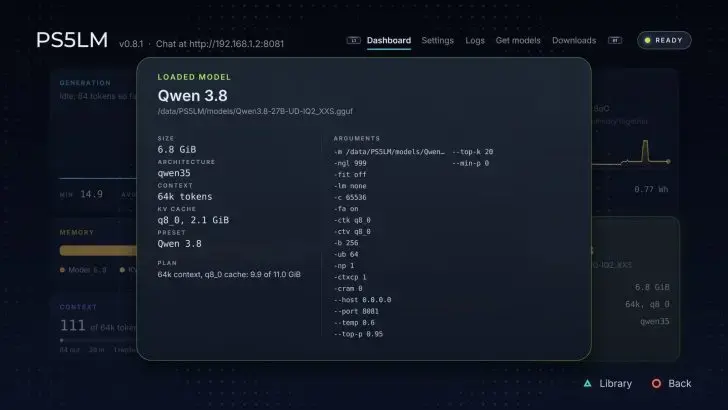
Model Sizes Shrink via Advanced Quantization Techniques
Running a standard 27B parameter model at 16-bit precision would normally require 54GB of VRAM, far exceeding the physical limitations of the PlayStation 5. To address this, the project utilized 2-bit quantization, which compressed the model weights down to approximately 6.8GB. While this process results in a slight decrease in logical accuracy and reasoning depth, it enables the model to operate within the console’s constrained environment. When utilizing a 64K context window, the system consumes nearly 91 percent of its available memory, showcasing the high-performance threshold of the hardware. 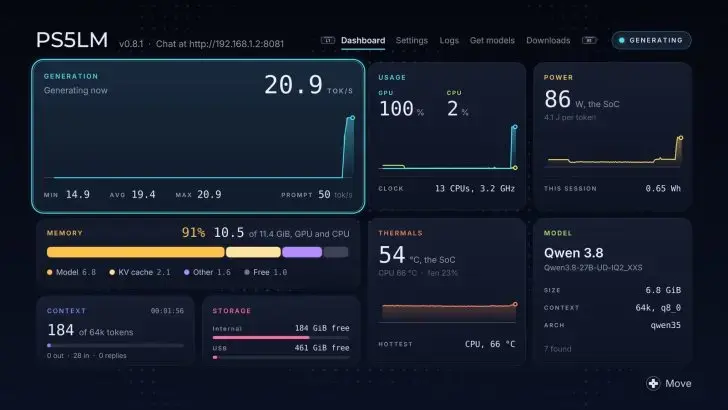
Performance Metrics Exceed Initial Industry Expectations
In rigorous testing environments, the Qwen3.8-27B model achieved a generation speed of 20.9 tokens per second, with the GPU utilization peaking at 100 percent while the CPU remained idle at 2 percent. Lighter models yielded even more impressive results; the Gemma 4 E4B model reached 61 tokens per second, and the Llama 3.2 3B model hit 124 tokens per second. Notably, the console maintained a stable operating temperature of 54°C during these intense tasks, proving the efficiency of the custom cooling architecture. Despite these breakthroughs, users must acknowledge that such modifications are strictly intended for technical research and carry significant security implications for the average consumer.
Do you believe that gaming consoles could eventually serve as viable, budget-friendly hardware alternatives for running local artificial intelligence models? Would you be willing to void your console warranty to experiment with these powerful AI capabilities, or do you prefer to keep your gaming hardware strictly for entertainment? Share your thoughts and technical perspectives in the comments section below.
Your comment has been submitted,
it will be published after approval.