
Kioxia Unveils LD4 SSD Series Featuring 122 TB Capacity

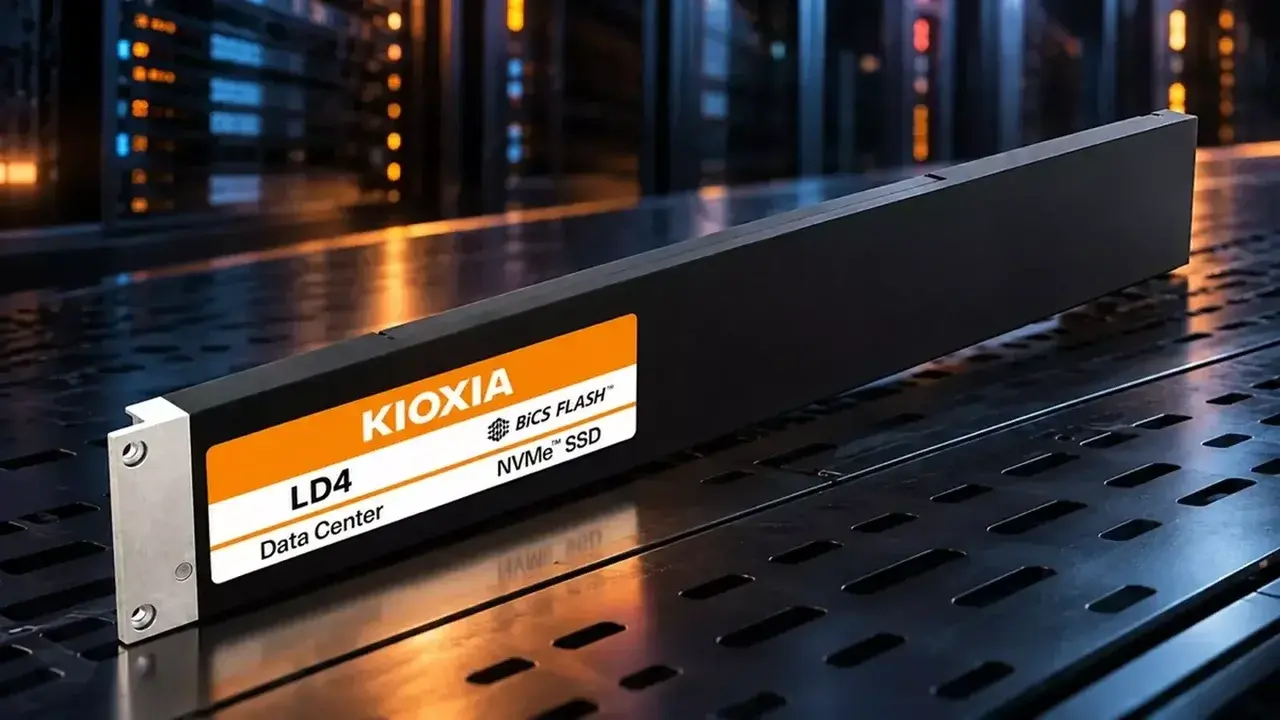
Japanese memory manufacturer Kioxia has officially introduced its new LD4 SSD series, a high-density storage solution engineered specifically to meet the intensive capacity requirements of modern data centers. Unveiled to address the growing demand for large-scale infrastructure, these storage units utilize the E1.L form factor and are capable of reaching massive capacities of up to 122.88 TB. By leveraging advanced architectural designs, Kioxia aims to provide server operators with enhanced efficiency for read-intensive workloads and cloud storage environments. The company has already begun distributing initial samples of 15.36 TB and 30.72 TB variants to select industry partners for validation purposes.
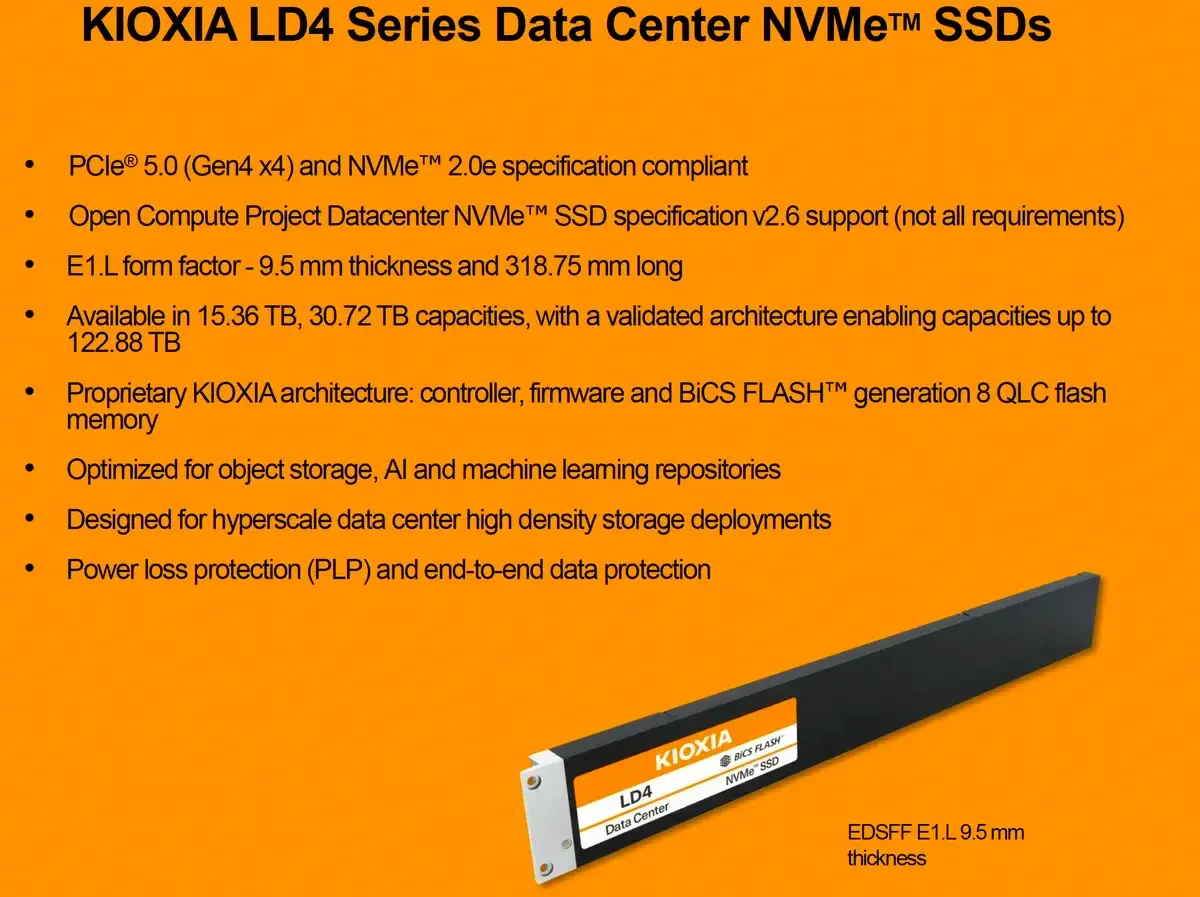
- The LD4 series utilizes eighth-generation BiCS FLASH 3D QLC NAND technology to maximize storage density per cell.
- These SSDs employ the E1.L form factor to optimize space efficiency within standard 1U server chassis.
- The hardware architecture supports PCIe 5.0 compliance and adheres to the OCP Datacenter NVMe SSD Specification 2.6.
Advanced NAND Technology Drives Higher Capacities
At the heart of the LD4 series lies the eighth-generation BiCS FLASH 3D QLC NAND technology. This innovation allows Kioxia to pack four bits of data into every individual memory cell, significantly increasing the total storage density without requiring additional physical space. While the flagship 122.88 TB model remains a future development, the underlying architecture has been fully verified for stability and performance. This high-capacity design is particularly advantageous for operators looking to maximize their existing rack footprint by fitting more data into a single 1U enclosure.
Form Factor Enhances Server Efficiency
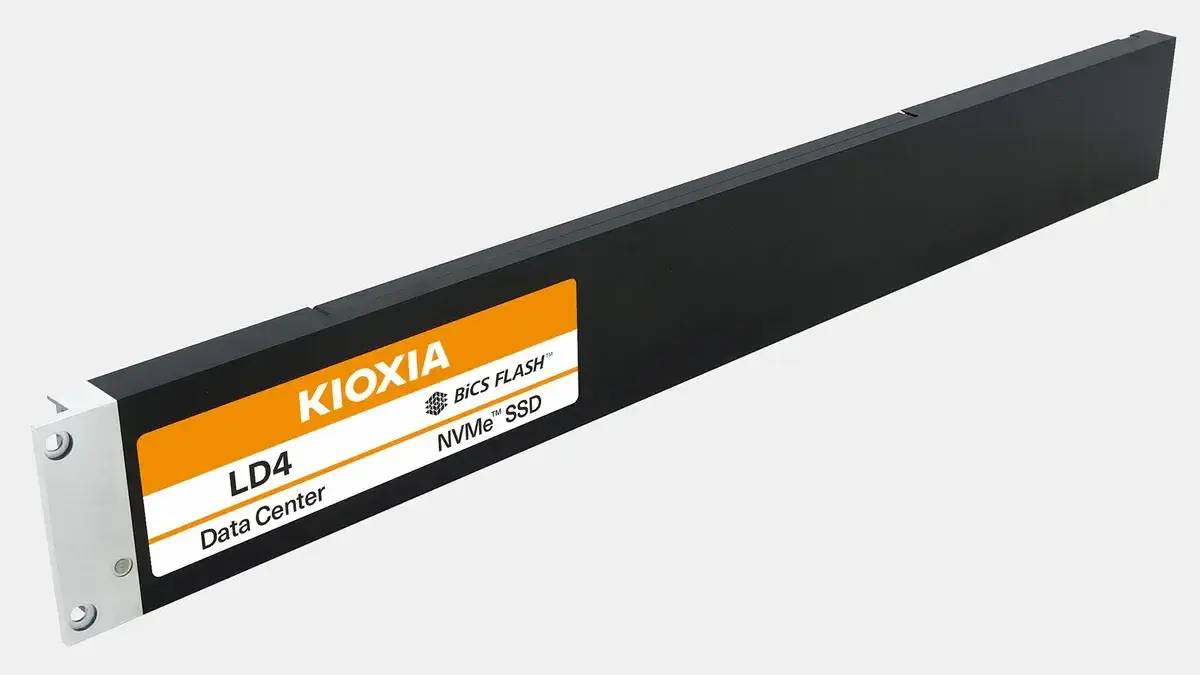
The transition to the E1.L form factor represents a strategic shift for Kioxia, moving away from traditional 2.5-inch drive designs to a long, slender configuration. Measuring 318.75 mm in length and only 9.5 mm in thickness, these drives allow for the stacking of numerous NAND packages on a single circuit board. This physical arrangement is crucial for data centers that require high-density storage solutions to support artificial intelligence training sets and massive object storage systems. By utilizing this elongated structure, administrators can achieve superior thermal management and space utilization in dense server environments.
Technical Standards Support Future Integration
Although the LD4 series is fully compatible with the PCIe 5.0 standard, the current implementation operates at PCIe 4.0 x4 transfer speeds. This connection provides a theoretical bandwidth of approximately 7.88 GB/s, ensuring fast data throughput for read-heavy operations. The drives are compliant with the NVMe 2.0e standard and meet the specific requirements outlined by the Open Compute Project. While Kioxia has not yet released specific metrics regarding IOPS, latency, or endurance ratings like DWPD and TBW, the company plans to showcase these units at the upcoming OCP Global Summit in San Jose, scheduled for October 2026. As the industry moves toward more robust storage solutions, the scalability of these drives will likely play a pivotal role in the future of cloud computing architecture. We invite you to share your thoughts in the comments section regarding how these high-capacity drives might transform your own data management strategies.
Given the rapid expansion of data-hungry applications, how do you foresee these ultra-high-capacity SSDs changing the landscape of data center design in the next few years?
Your comment has been submitted,
it will be published after approval.