
NVIDIA Remains Indifferent to Emerging HBF Memory Technology

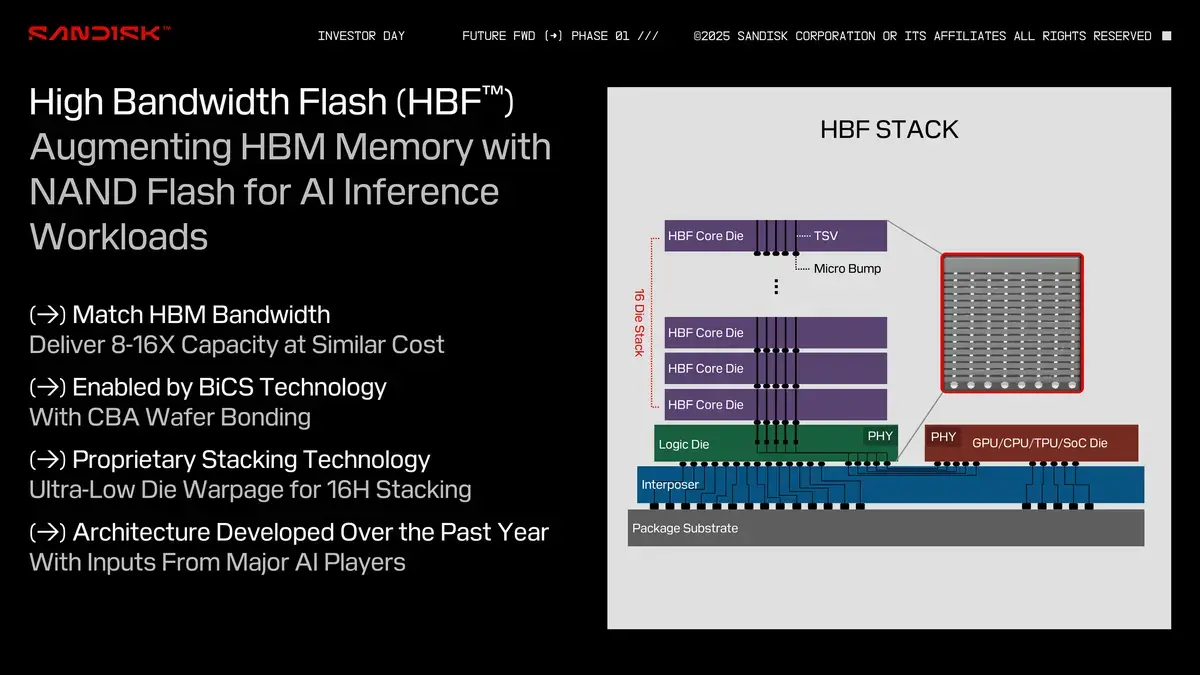
High Bandwidth Flash (HBF) memory technology, developed by SanDisk and SK Hynix, has emerged as a potential alternative to HBM in the artificial intelligence sector, yet NVIDIA has reportedly shown little interest in adopting this solution. While HBF promises capacities reaching up to 4 TB and is scheduled to enter the sampling phase in the second half of this year, NVIDIA is choosing to bypass this technology. Instead, the industry leader is focusing on advanced eSSD solutions to overcome existing memory bottlenecks. This divergence in strategic direction between NVIDIA and other major tech players highlights a shifting landscape for high-performance AI infrastructure standards.
- HBF technology achieves storage capacities of up to 4 TB, surpassing the limits of traditional HBM solutions.
- NVIDIA prioritizes the development of PCIe Gen7 SSDs in collaboration with Kioxia over adopting HBF.
- Google plans to integrate HBF technology to support the expanding requirements of its proprietary TPU ecosystem.
- Industry experts expect the first commercial samples of HBF memory to arrive by the second half of 2026.
HBF technology could significantly improve server-side efficiency by replacing conventional DDR memory architectures.
NVIDIA Prefers SSD Solutions Over HBF Technology
NVIDIA maintains a distinct roadmap for addressing memory constraints in AI-driven workloads. The company asserts that the bandwidth requirements currently demanded by modern data centers can be adequately satisfied through existing eSSD technologies. By leveraging these high-speed storage solutions, NVIDIA aims to maintain its current hardware architecture without the complexity of integrating a new, unproven memory standard.
A critical component of this strategy involves a partnership with Kioxia to produce PCIe Gen7 SSDs, which are expected to perform up to 100 times faster than standard industry models. This approach allows NVIDIA to achieve substantial performance gains while maintaining compatibility with its established infrastructure, minimizing the need for radical design overhauls.
Google Targets HBF to Expand TPU Capabilities
In contrast to NVIDIA’s cautious approach, Google is actively evaluating HBF technology to enhance its own TPU ecosystem. As the company scales its AI projects, it faces increasing demand for greater memory capacity to handle complex inference tasks. HBF offers a compelling solution by providing high-density memory that could effectively remove existing bottlenecks in data processing.
Furthermore, the multi-layered stack design of HBF provides significant advantages in physical space, allowing for more efficient PCB utilization and lower power consumption. By adopting this technology, Google aims to optimize its server efficiency and support the next generation of massive AI models.
The widespread adoption of HBF could trigger a fundamental revolution in server memory design.
Do you believe NVIDIA’s SSD-focused strategy will remain competitive against the high-capacity potential of HBF? Share your thoughts on the future of AI memory infrastructure in the comments below.
Your comment has been submitted,
it will be published after approval.