
Samsung Exynos 2700 Targets Peak Performance With Advanced Cooling

Samsung is currently accelerating the development of its next-generation Exynos 2700 chipset, aiming to bridge the performance gap caused by its 2nm GAA production process through innovative thermal management solutions. As the South Korean tech giant faces stiff competition from TSMC’s N2P node in Power, Performance, and Area (PPA) metrics, it is leveraging proprietary, high-end heat dissipation architectures to ensure its flagship processors maintain sustainable performance levels under heavy workloads. By integrating these advanced cooling technologies, Samsung intends to keep its hardware competitive against future Snapdragon and Dimensity platforms while addressing the inherent thermal challenges of its latest manufacturing nodes.
- Samsung is utilizing advanced cooling architectures to compensate for efficiency deficits in its 2nm GAA production process.
- The Exynos 2700 incorporates the new Side-By-Side and Heat Pass Block cooling designs to enhance thermal stability.
- TSMC’s 2nm N2P process currently maintains a lead over Samsung’s GAA technology in industry PPA benchmarks.
- Samsung’s cooling innovations are designed to maintain competitiveness against upcoming high-performance mobile chipsets.
Exynos 2700 Utilizes New Cooling Architectures
The company previously introduced the Heat Pass Block (HPB) technology with the Exynos 2600, which delivered surprising thermal efficiency, outperforming even liquid-nitrogen-cooled competitors in specific testing environments. 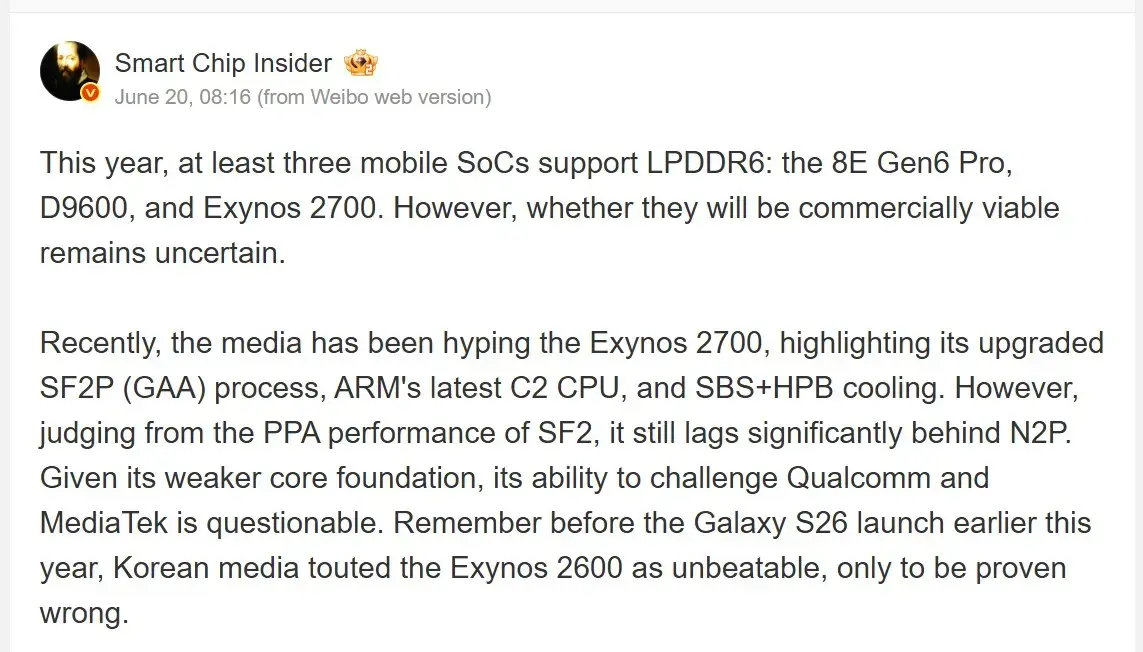 Building upon this success, the upcoming Exynos 2700 is expected to feature the Side-By-Side (SBS) architecture, a secondary cooling mechanism designed to maintain thermal equilibrium during intensive tasks. This hardware-level approach is not merely a cosmetic fix for manufacturing shortcomings but represents a mandatory shift toward managing high-power density in modern mobile devices.
Advanced cooling technologies have become an essential requirement for maintaining sustainable processor performance in the modern era.
Competitive Challenges Persist in the Market
Market analysts note that while Samsung has made significant strides in improving its semiconductor manufacturing, the 2nm GAA node still faces hurdles compared to its rivals. The industry is closely watching how the Exynos 2700 performs against upcoming flagship competitors like the Snapdragon 8 Elite Gen 6 Pro and the Dimensity 9600. To remain a viable alternative for handset manufacturers, Samsung must ensure that these cooling solutions effectively mitigate the high power consumption profiles that have characterized its recent high-end silicon. Reports suggest that the chip may draw up to 30W under full load, necessitating sophisticated thermal management to prevent throttling.
Cooling Solutions Set New Industry Standards
The impact of Samsung’s thermal innovations extends beyond its own product lineup, as industry reports suggest that competitors are studying these designs for their future flagship developments. Qualcomm is reportedly evaluating similar heat dissipation concepts for its own high-end Snapdragon iterations, signaling that mobile cooling is becoming a primary battleground for performance supremacy. By successfully implementing these designs in the Exynos 2700, Samsung hopes to deliver laptop-level processing power within the compact confines of a smartphone form factor without sacrificing user experience or device longevity.
Do you believe that Samsung can successfully overcome its manufacturing challenges through hardware-based cooling solutions alone, or does the company need a more fundamental shift in its production processes? We invite you to share your thoughts and expectations regarding the upcoming Exynos 2700 in the comments section below.
Your comment has been submitted,
it will be published after approval.