
Snapdragon 8 Elite Extreme Gen 6 and Dimensity 9600 Pro Face Off

In September 2026, industry giants Qualcomm and MediaTek unveiled their latest flagship processors, the Snapdragon 8 Elite Extreme Gen 6 and the Dimensity 9600 Pro, marking a significant evolution in mobile computing. Built upon TSMC’s cutting-edge 2nm manufacturing process, these chipsets power high-end devices such as the Xiaomi 18 Pro Max and the Vivo X500 Pro Max. The simultaneous launch of these processors signals a new era for smartphone performance, focusing on advanced artificial intelligence integration and superior image processing capabilities. As both companies strive for dominance, their competing architectures are set to redefine standards for mobile gaming, professional video production, and overall device efficiency.
- Both processors utilize TSMC’s advanced 2nm fabrication technology to achieve significant improvements in power efficiency.
- The Snapdragon 8 Elite Extreme Gen 6 excels in single-core performance while the Dimensity 9600 Pro leads in multi-core processing tasks.
- Integrated AI processing within the GPU architecture reduces latency for real-time visual tasks.
Technical Specifications Define New Performance Standards
The new generation of mobile silicon emphasizes architectural refinement and aggressive clock speeds. The Snapdragon 8 Elite Extreme Gen 6 asserts its dominance in raw power by featuring prime cores capable of reaching 5.0 GHz. This approach prioritizes peak performance for demanding applications and high-end gaming.
Conversely, MediaTek has opted for a highly customized 2+3+3 core arrangement in the Dimensity 9600 Pro to optimize throughput for multi-threaded workloads. Both platforms have adopted the latest industry standards, offering full support for LPDDR6 memory and UFS 5.0 storage, ensuring that data transfer rates remain unconstrained by hardware bottlenecks.
Benchmark Tests Highlight Different Strengths
Performance analysis via Geekbench 7 reveals that the Snapdragon 8 Elite Extreme Gen 6 maintains a 21% advantage in single-core operations. However, the Dimensity 9600 Pro demonstrates superior efficiency in multi-core scenarios, capturing a slight lead in overall system stability during heavy load testing. 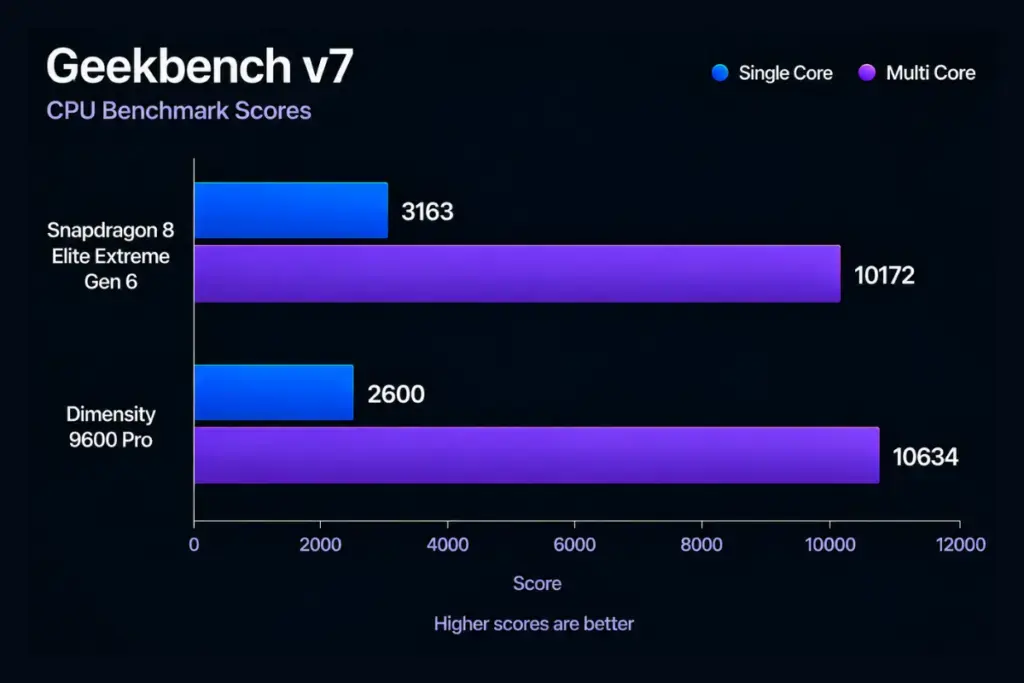
AnTuTu benchmarks present a nuanced picture of this rivalry. While the Snapdragon chipset secures a roughly 6% lead in aggregate scoring, the MediaTek solution achieves a 5% higher score in graphics processing unit (GPU) performance. This indicates that while Qualcomm focuses on raw computational power, MediaTek prioritizes graphical fluidity and integrated gaming performance. 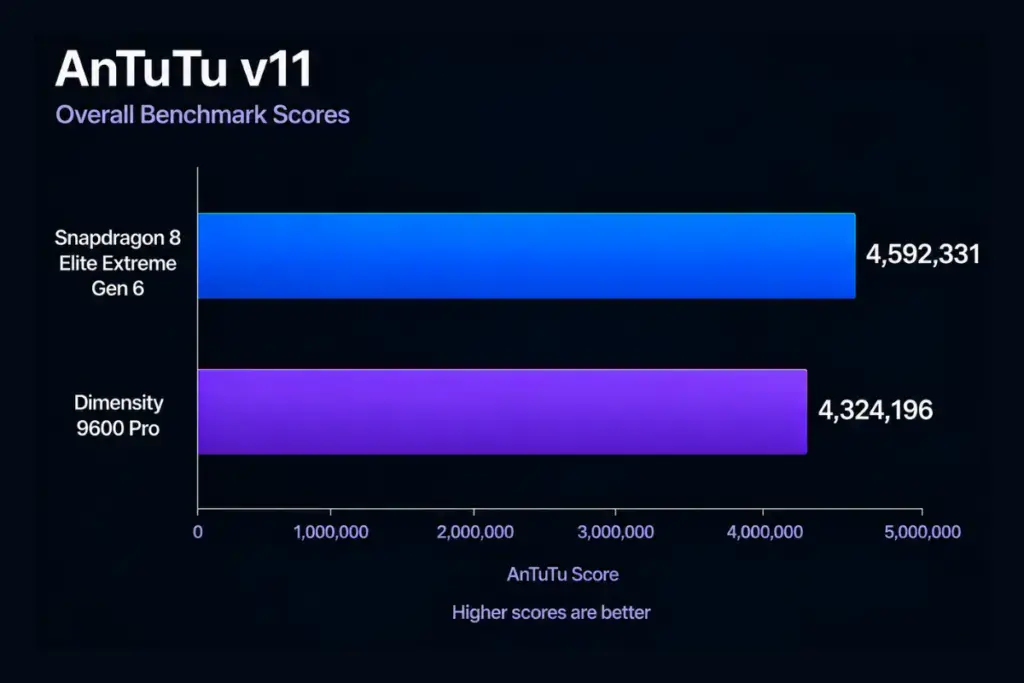
AI and Imaging Capabilities Are Evolving
Innovation extends deep into the realm of machine learning. The Snapdragon 8 Elite Extreme Gen 6 introduces an architectural shift where AI workloads are processed directly on the GPU. This strategy bypasses the need for constant data transmission to the NPU, effectively minimizing latency for intensive visual tasks.
MediaTek, meanwhile, utilizes its NPU 1090 as a centralized coordination hub, synchronizing AI operations across the CPU and GPU simultaneously. In terms of videography, both chipsets have established new benchmarks, supporting 8K video capture at 60fps and 4K slow-motion recording at 240fps for professional-grade results.
The Future of Mobile Devices Is Taking Shape
Although these high-performance chips are currently exclusive to the Chinese market, a global rollout is expected in the coming months. The 2nm process delivers approximately 37% better energy efficiency, suggesting that next year’s flagship smartphones will offer both increased speed and extended battery endurance. The ultimate success of these platforms will depend heavily on the software optimizations implemented by device manufacturers.
How do you view the transition to 2nm chip architecture in terms of your daily mobile experience? Do you prioritize the raw power of the Snapdragon series or the multi-core efficiency offered by MediaTek? Share your thoughts and your preferred chipset choice in the comments section below.
Your comment has been submitted,
it will be published after approval.