
Apple M5 Max Shines in Performance Tests

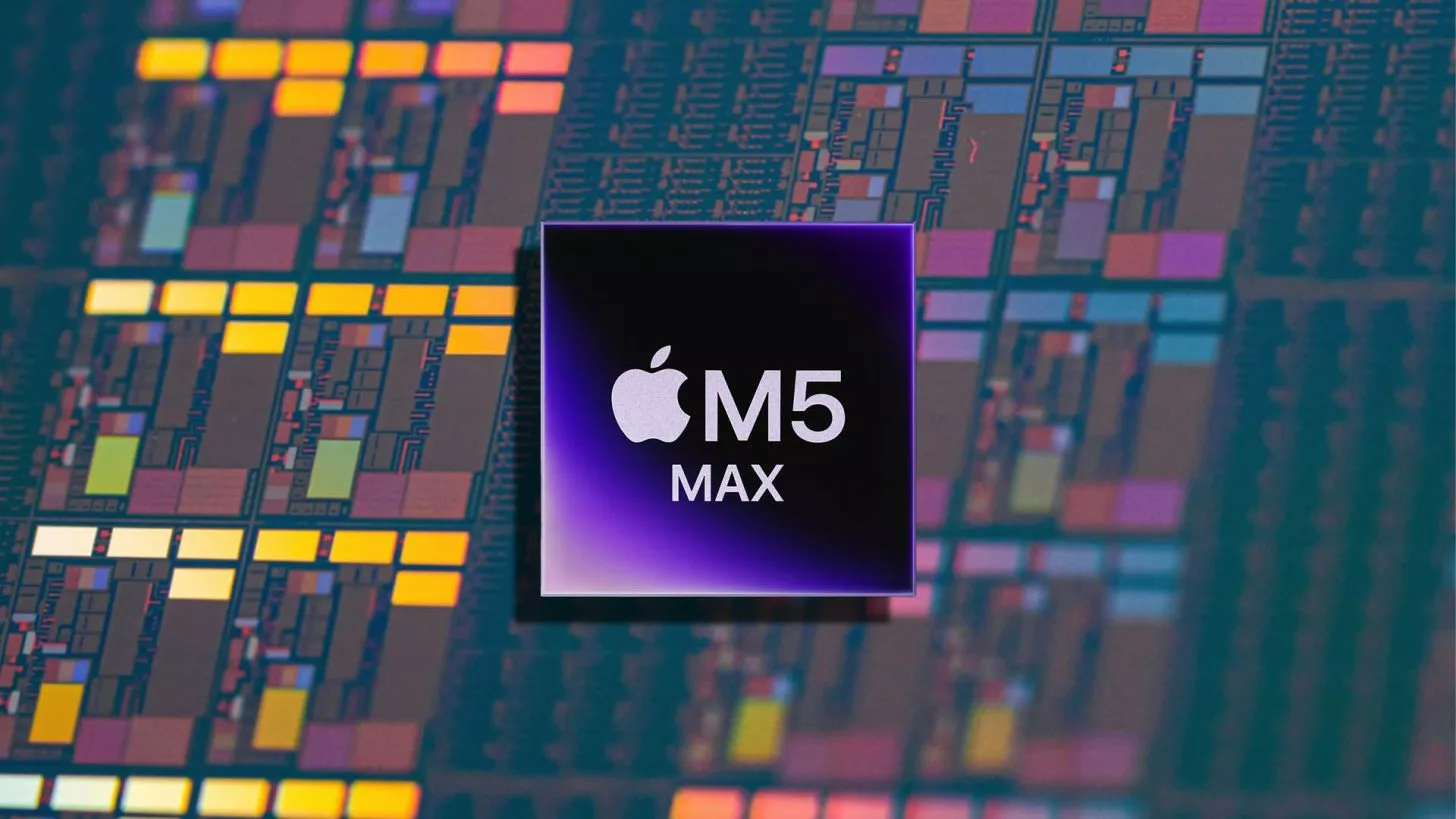
Since transitioning to its own silicon architecture, Apple has continued to shift the balance in the laptop market. The first Geekbench performance test results for the Apple M5 Max processor, which powers the newly announced next-generation MacBook Pro models expected to hit shelves by March 11, have been leaked.
These initial findings clearly demonstrate that Apple has not only surpassed its own limits but has also achieved a level of mobile power that could rival even desktop workstations.
Apple M5 Max: A Significant Leap Over the M4 Max
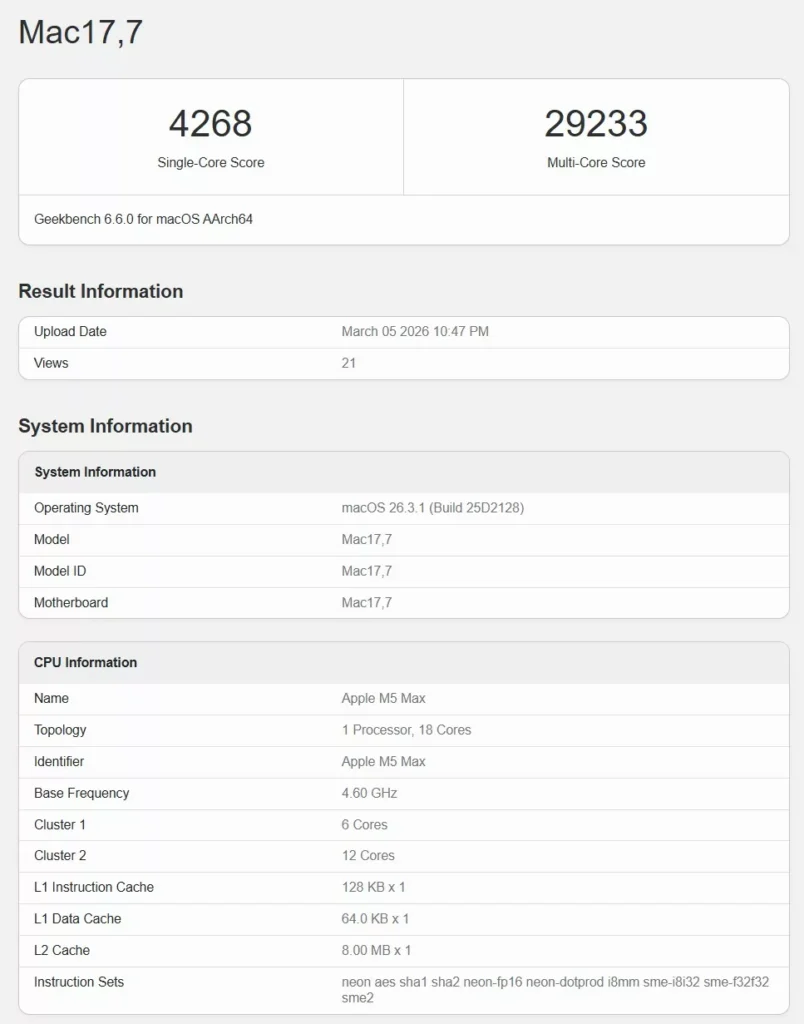
According to the results posted on the Geekbench database, the M5 Max, which has an 18-core CPU (6 performance cores, 12 efficiency cores), scores 4,268 in the single-core test and 29,233 in the multi-core test. Compared to the previous generation’s top model, the 16-core M4 Max, these figures indicate a steady performance increase of approximately 10 to 15 percent in both single-core and multi-core tests.
At first glance, this generational difference may not seem huge; it is well known that Apple’s main focus here is on maintaining stability by preserving battery life and thermal efficiency rather than pure performance gains. However, the real surprise of this test lies in the rest of the table.
The Real Victory: Dethroning the 32-Core M3 Ultra
The detail that really made headlines about the M5 Max was that it outperformed Apple’s 32-core M3 Ultra processor, which is designed for professional desktop systems like the Mac Studio and Mac Pro.
To compare, in Geekbench data, the M3 Ultra, with its massive cooling blocks, scored an average of 28,169 points in multi-core tests, while the new laptop-form M5 Max easily outshines its big brother with 29,233 points. The fact that a laptop chip can outperform a workstation chip with nearly twice as many CPU cores (18 vs. 32) and much higher power consumption is the most concrete proof of the latest advances in mobile processor technology.
The New “Fusion” Architecture and TSMC’s 3nm Power
So how was this achieved? According to industry sources, the key factors behind the M5 Max’s impressive performance are TSMC’s advanced 3nm (N3P) manufacturing process and Apple’s new chip design, dubbed the “Fusion Architecture.”
Unlike the monolithic structure of the past, this design combines CPU and GPU blocks using advanced packaging technology, maximizing heat management and accelerating data transmission between hardware components. Moreover, a performance increase of up to 4 times in artificial intelligence processes such as Large Language Models (LLM) is just one of the fruits of this new architecture.
The MacBook Pro models with the Apple M5 Max chip, now available for pre-order and eagerly awaited by hardware enthusiasts, will raise the bar to an unattainable level for professionals working with rendering, 3D modeling, or complex software compilation on mobile platforms. We will see much more clearly how the test results translate to the end-user experience in the coming days when the devices are released.
Your comment has been submitted,
it will be published after approval.