
Apple Maintains Dominance in Global Premium Smartphone Market

According to the latest data released by Counterpoint Research, the global premium smartphone market, defined as devices priced at $600 or above, reached 29% of total global sales during the first half of 2026. This significant segment experienced a four-percentage-point increase compared to the same period in the previous year. Apple remains the undisputed leader in this category, capturing a 65% market share, an improvement from the 63% share it held in the first half of 2025. This growth demonstrates Apple’s continued ability to maintain consumer loyalty and expand its footprint in the high-end mobile sector despite intense global competition.
- Apple increased its premium market share to 65% during the first half of 2026.
- The iPhone 17 series served as a primary catalyst for Apple’s 9% year-on-year growth.
- Samsung solidified its position in the premium segment with a 19% market share.
- Rising component costs are narrowing the price gap between mid-range and premium smartphones.
iPhone 17 Series Drives Market Expansion
The impressive 9% year-on-year growth reported by Apple is primarily attributed to the robust performance of the iPhone 17 series. Analysts highlight that the standard model within this lineup generated substantial consumer interest, effectively allowing the company to recover from previous competitive setbacks in the Chinese market. This resurgence underscores the brand’s resilience and its strategic success in product positioning. 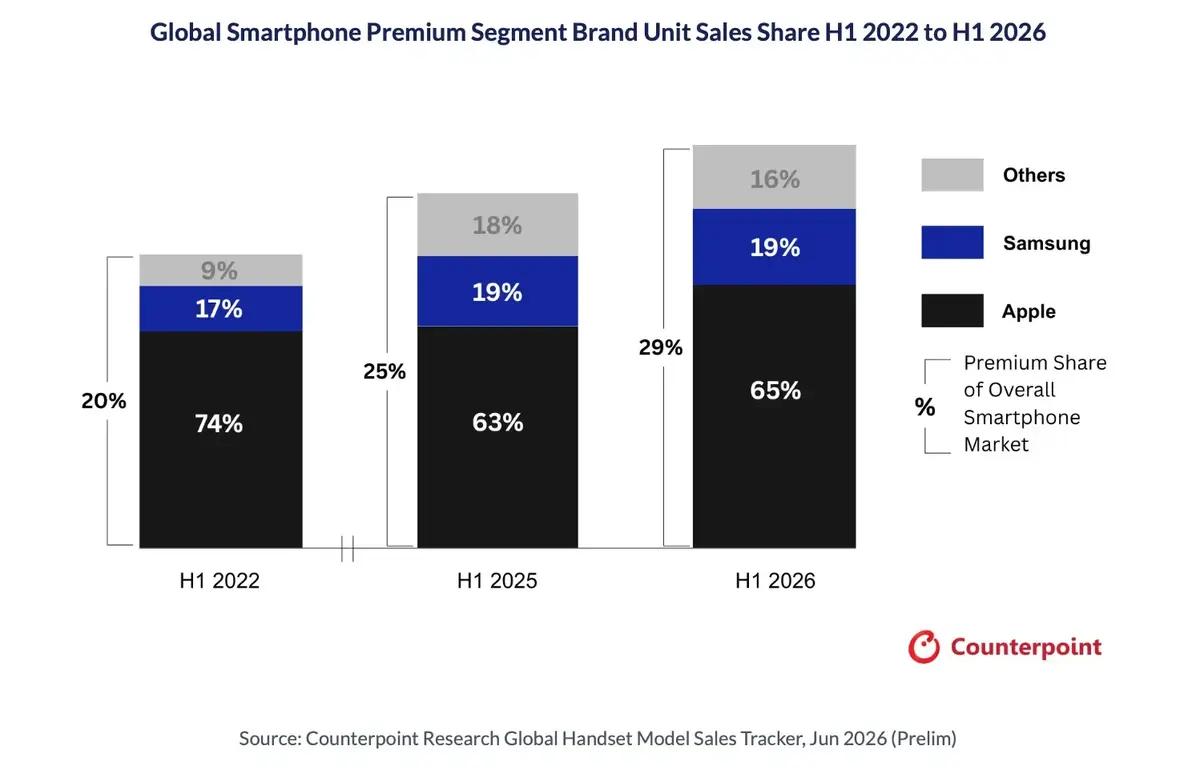
The strategic success of the iPhone 17 lineup has effectively neutralized recent competitive pressures in key international regions.
Samsung Maintains Steady Growth in Premium Segment
While Apple leads, Samsung continues to demonstrate a consistent performance, holding a 19% market share in the premium smartphone category. Since 2022, when its share stood at 17%, the company has achieved a gradual and steady upward trajectory. Samsung’s ability to sustain its market position is supported by its commitment to flagship innovation and the expansion of its global presence.
Rising Component Costs Reshape Market Dynamics
Industry experts observe that increasing costs for memory and essential components are fundamentally altering smartphone pricing structures. As mid-range Android devices face rising production costs, the price disparity between these handsets and premium flagships is rapidly shrinking. This convergence makes it easier for consumers to justify upgrading to higher-tier devices, as the value proposition of premium hardware becomes more accessible.
The closing price gap between mid-range and premium handsets is fundamentally changing consumer purchasing behavior globally.
Financial Programs Facilitate Premium Device Adoption
To support the shift toward higher-end devices, manufacturers are aggressively expanding financing, trade-in, and buy-back programs. Brands like Samsung are scaling initiatives such as Galaxy Forever across multiple territories to simplify access to flagship technology. These financial support structures are proving essential in keeping demand for premium smartphones resilient against broader economic fluctuations. Looking ahead, analysts expect the premiumization trend to persist, driven by improved component supply chains and sustained consumer demand for high-performance mobile hardware. The prevalence of flexible financing options remains a critical factor in the ongoing evolution of the global smartphone landscape.
As the premium smartphone segment continues to capture a larger share of the global market, we would love to hear your perspective on this trend. Do you believe this shift toward high-end devices will eventually lead to the disappearance of the mid-range smartphone market, or will manufacturers find a new balance? Share your thoughts in the comments section below.
Your comment has been submitted,
it will be published after approval.