
M4 Mac Mini Becomes Portable ‘Mac Nano’ Handheld PC

In a remarkable feat of engineering, the M4-powered Mac Mini, one of Apple’s latest desktop computers, has transcended its traditional boundaries to become a fully portable, handheld device. Developed by Shing Solutions, this custom-built computer, dubbed ‘Mac Nano,’ integrates the original Mac Mini hardware into a specially designed 3D-printed chassis. This innovative project showcases how powerful desktop components can be reimagined for a mobile form factor, offering users the full macOS experience on the go.
- The Mac Nano project successfully converted an M4 Mac Mini into a portable handheld computer.
- Shing Solutions developed the Mac Nano by integrating original Mac Mini hardware into a custom 3D-printed body.
- The device retains the M4 Mac Mini’s original motherboard and cooling system, ensuring consistent performance.
- It features a 7-inch 120Hz touchscreen, an integrated QWERTY keyboard, and physical gaming controls.
The Mac Nano Redefines Portable Computing Standards
The concept of transforming a powerful desktop machine like the M4 Mac Mini into a mobile unit is a significant departure from conventional computing. Shing Solutions’ Mac Nano demonstrates a bold vision where high-performance hardware, typically confined to a desk, can be carried and operated anywhere. This project underscores the potential for hardware modding to unlock new functionalities and user experiences from existing technology, challenging the perceived limitations of compact desktop computers.
Innovative Hardware Integration and Design Were Achieved
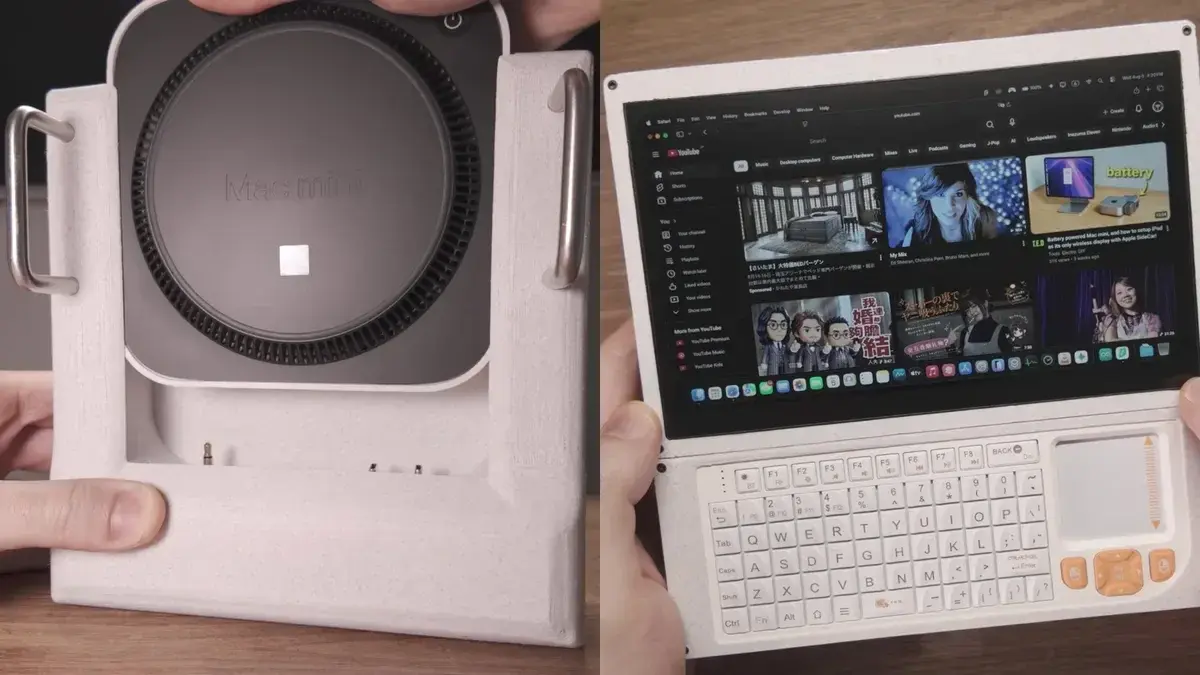
The development of the Mac Nano involved a meticulous process of disassembling the M4 Mac Mini. Its core components, including the motherboard and the original blower-type fan system, were carefully extracted and transferred into the new, custom-designed 3D-printed enclosure. Crucially, Apple’s factory thermal management system was preserved, ensuring that the device maintains its optimal cooling performance even in its new portable form.
A key design feature is the modular structure of the main computer section. Instead of being permanently affixed, the motherboard and cooling assembly are mounted on a rail system. This ingenious design allows the primary computer module to slide out effortlessly, enabling maintenance or upgrades without requiring a complete disassembly of the entire device.
The front of the Mac Nano features a vibrant 7-inch touchscreen display with a smooth 120 Hz refresh rate, providing an interactive interface for macOS. Directly beneath the screen, a compact QWERTY keyboard is integrated, complete with an embedded touchpad. Initially designed as a wireless accessory, the keyboard was re-engineered to draw power directly from the Mac Nano via a USB connection, eliminating the need for separate charging.
Gaming Controls and Robust Power Management Were Incorporated
To enhance its versatility, particularly for gaming, the Mac Nano incorporates physical controls on its side panels. These controls utilize circuit boards salvaged from Nintendo Joy-Con Charging Grip accessories, offering a tactile gaming experience. Uniquely, these controllers are hardwired directly to the Mac Nano rather than relying on Bluetooth, ensuring a stable connection.
Since macOS does not natively support wired Joy-Con connections, the input from these controllers is routed and mapped through Steam’s robust controller management system. Peripheral connectivity within the device is managed by a custom-integrated three-port USB hub, efficiently handling connections for the various components.
For true portability, the Mac Nano is equipped with a custom-engineered battery system. Rechargeable cells and a sophisticated power distribution network are housed within the chassis, allowing the M4 Mac Mini’s motherboard to operate independently of an external power source. The 3D-printed case also features ergonomic, wide grip sections on its sides, designed to facilitate comfortable handheld use.
All these integrated components work in harmony to ensure that the Mac Mini’s original functionalities within the macOS operating system remain entirely intact. The Mac Nano thus delivers a full desktop experience in a uniquely portable format.
This ambitious project challenges conventional notions of desktop computing. Do you believe such transformations of powerful hardware into portable devices could become a significant trend in the future? Share your thoughts and predictions in the comments below.
Your comment has been submitted,
it will be published after approval.