
Why Developers Are Moving Projects from Shared Hosting to VPS Servers


Learn why developers move from shared hosting to VPS servers as projects grow: root access, custom software stacks, predictable resources, background jobs, automation, stronger isolation, security settings and a clearer path to scalable cloud infrastructure.
Shared hosting has helped developers launch websites and applications quickly. It is cheap, simple and requires little server knowledge. But once a project grows, the same simplicity becomes a limitation. Developers need more control, performance and an environment that supports application logic.
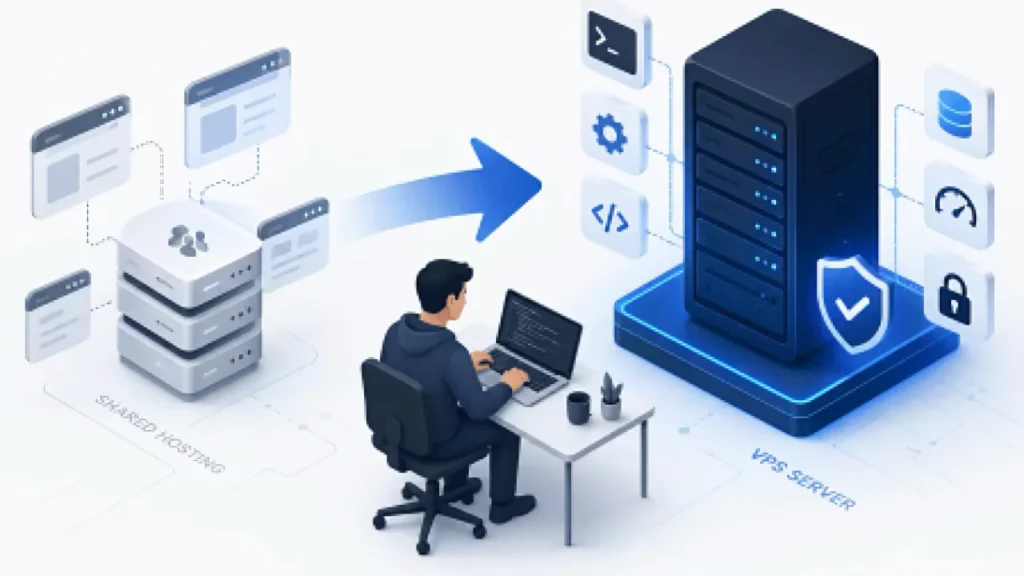
That is why startups and teams move from shared hosting to VPS hosting. A virtual private server gives them dedicated resources, root level access and freedom to configure the stack. For applications, automation tools, APIs and scalable cloud projects, that flexibility matters more than low monthly price.
Why Do Developers Need More Control over the Software Stack?
On shared hosting, developers work inside a fixed environment. The provider decides PHP versions, database settings, packages and security rules. This can be acceptable for basic websites, but it becomes restrictive when a project needs Node.js, Python services, queues, Docker, Redis or specific extensions.
With a VPS, the team can choose the operating system, install tools, configure web servers and adjust runtime settings. This makes the server closer to the needs of the application.
When Custom Configuration Matters
Custom configuration becomes important when a project needs:
- specific language versions
- background workers
- API services
- task queues
- custom caching
- deployment scripts
- staging environments
These are common requirements for modern development, but they are difficult to manage on shared hosting.
Better Performance for Growing Projects
Shared hosting means many websites use the same server resources. If another account receives heavy traffic or runs inefficient scripts, performance can suffer. Developers may notice slow responses, database delays or limits during traffic peaks.
A VPS provides a predictable allocation of CPU, RAM and storage. It does not promise unlimited power, but it gives teams a clearer view of available resources. That makes troubleshooting easier and helps applications behave consistently under load.
For startups, this stability is valuable. A product demo, beta launch or campaign can bring sudden traffic. If the infrastructure cannot handle it, users may leave before the team gets feedback.
Why Automation Needs a Stronger Environment
Many developer projects are no longer just websites. They include cron jobs, scraping tasks, notification systems, report generators, data imports and integrations with third party APIs. These processes often need to run in the background.
Shared hosting can restrict long running scripts or background tasks. A VPS gives developers freedom to schedule jobs, monitor processes and restart services.
Typical Automation Use Cases
A VPS is useful for automation such as:
- daily database backups
- inventory synchronization
- email processing
- webhook processing
- log analysis
- data transformation scripts
- scheduled API calls
- internal business tools
These tasks may look small at first, but they become critical when a business depends on them.
Security and Isolation
Security is another reason developers leave shared hosting. In a shared environment, accounts are separated, but the infrastructure is still built for many users on one server. A VPS gives teams stronger isolation and more responsibility over access, firewall rules and monitoring.
This is useful for projects that handle customer data, payment workflows, private dashboards or internal tools. Developers can limit open ports, manage SSH keys and define backup routines.
A Practical Step Toward Scalable Cloud Projects
Moving to a VPS does not mean every team needs complex enterprise cloud infrastructure. For many developers, it is a practical middle step. It offers more control than shared hosting, but remains easier than managing cloud services.
For applications, websites, automation tools and growing digital products, a VPS creates room to build properly. It gives developers the environment they need today and a clearer path to scale tomorrow.
Your comment has been submitted,
it will be published after approval.